Application
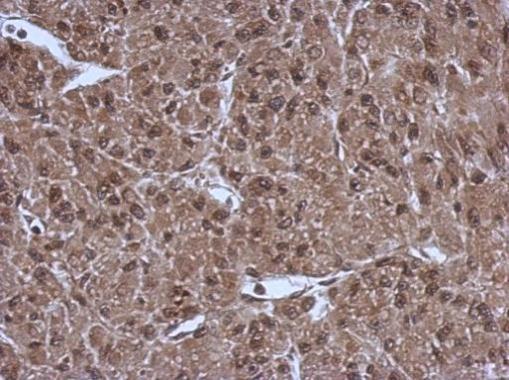
Immunohistochemical analysis of paraffin-embedded U87 xenograft, using PSMC3 antibody at 1:500 dilution.Application
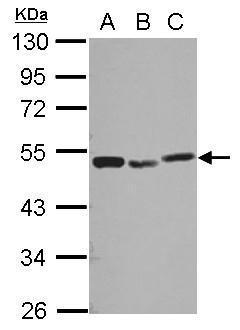
Sample (30 ug of whole cell lysate) A: 293T B: A431 C: HepG2 10% SDS PAGE diluted at 1:5000| Product Name | PSMC3 antibody |
|---|---|
| Antibody Type | Primary Antibodies |
| Product description | Rabbit Polyclonal antibody to PSMC3 (proteasome (prosome, macropain) 26S subunit, ATPase, 3)The 26S proteasome is a multicatalytic proteinase complex with a highly ordered structure composed of 2 complexes, a 20S core and a 19S regulator. The 20S core is composed of 4 rings of 28 non-identical subunits; 2 rings are composed of 7 alpha subunits and 2 rings are composed of 7 beta subunits. The 19S regulator is composed of a base, which contains 6 ATPase subunits and 2 non-ATPase subunits, and a lid, which contains up to 10 non-ATPase subunits. Proteasomes are distributed throughout eukaryotic cells at a high concentration and cleave peptides in an ATP/ubiquitin-dependent process in a non-lysosomal pathway. An essential function of a modified proteasome, the immunoproteasome, is the processing of class I MHC peptides. This gene encodes one of the ATPase subunits, a member of the triple-A family of ATPases that have chaperone-like activity. This subunit may compete with PSMC2 for binding to the HIV tat protein to regulate the interaction between the viral protein and the transcription complex. A pseudogene has been identified on chromosome 9. [provided by RefSeq] |
| Immunogen | Recombinant protein encompassing a sequence within the center region of human PSMC3. The exact sequence is proprietary. |
| Clonality | Polyclonal |
|---|---|
| Isotype | IgG |
| Host Species | Rabbit |
| Tested Applications | IHC-PWB |
| *Optimal dilutions/concentrations should be determined by the researcher.
: |
|
| Species Reactivity | Human |
| Predicted Reactivity | Mouse, Rat, Zebrafish, Japanese medaka, Xenopus laevis, Chicken, Rhesus Monkey, BovineMouse (100%), Rat (99%), Zebrafish (97%), Japanese medaka (99%), Xenopus laevis (98%), Chicken (100%), Rhesus Monkey (100%), Bovine (100%) |
| Concentration | 1mg/ml (Please refer to the vial label for the specific concentration) |
| Purification | Affinity purified |
| Gene Synonyms | MGC8487 antibody TBP1 antibody PSMC3 antibody TBP-1 antibody human immunodeficiency virus tat transactivator binding protein-1 antibody proteasome subunit P50 antibody proteasome 26S subunit ATPase 3 antibody 26S proteasome AAA-ATPase subunit RPT5 a |
|---|---|
| Molecular Weight(MW) | 49 kDa (note) |
| Cellular Localization | Cytoplasm (Potential) , Nucleus |
Application
Immunohistochemical analysis of paraffin-embedded U87 xenograft, using PSMC3 antibody at 1:500 dilution.
Application
Sample (30 ug of whole cell lysate) A: 293T B: A431 C: HepG2 10% SDS PAGE diluted at 1:5000| Positive Control | 293T , A431 , HepG2 |
|---|---|
| Application Notes | *Optimal dilutions/concentrations should be determined by the researcher.
: |
| Form | Liquid |
|---|---|
| Storage Instructions | Keep as concentrated solution. Aliquot and store at -20ºC or below. Avoid multiple freeze-thaw cycles. |
| Storage Buffer | 1XPBS, 1% BSA, 20% Glycerol (pH7). 0.01% Thimerosal was added as a preservative. |


