Application
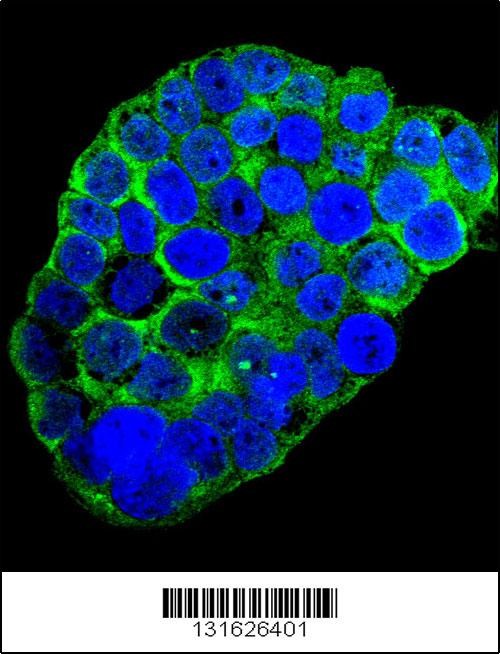
Confocal immunofluorescent analysis of C1QC Antibody with WiDr cell followed by Alexa Fluor? 488-conjugated goat anti-rabbit lgG (green). DAPI was used to stain the cell nuclear (blue).| Product Name | C1QC Antibody |
|---|---|
| Antibody Type | Primary Antibodies |
| Product description | This gene encodes a major constituent of the human complement subcomponent C1q. C1q associates with C1r and C1s in order to yield the first component of the serum complement system. A deficiency in C1q has been associated with lupus erythematosus and glomerulonephritis. C1q is composed of 18 polypeptide chains: six A-chains, six B-chains, and six C-chains. Each chain contains a collagen-like region located near the N-terminus, and a C-terminal globular region. The A-, B-, and C-chains are arranged in the order A-C-B on chromosome 1. This gene encodes the C-chain polypeptide of human complement subcomponent C1q. Alternatively spliced transcript variants that encode the same protein have been found for this gene.1) Fraser, D.A., et al. J. Immunol. 185(7):3932-3939(2010) |
| Immunogen | This C1QC antibody is generated from rabbits immunized with a KLH conjugated synthetic peptide between 93-120 amino acids from the Central region of human C1QC. |
| Clonality | Polyclonal |
|---|---|
| Isotype | Ig |
| Host Species | Rabbit |
| Tested Applications | IFIHC-PWB |
| For WB starting dilution is: 1:1000 For IHC-P starting dilution is: 1:10~50 For FACS starting dilution is: 1:10~50 For IF starting dilution is: 1:10~50 | |
| Species Reactivity | Human |
| Concentration | 1mg/ml |
| Purification | Affinity purified |
| Gene Symbol | C1QC |
|---|---|
| Alternative Names | Complement C1q subcomponent subunit C C1QC C1QG |
| Molecular Weight(MW) | 26 kDa |
Application
Confocal immunofluorescent analysis of C1QC Antibody with WiDr cell followed by Alexa Fluor? 488-conjugated goat anti-rabbit lgG (green). DAPI was used to stain the cell nuclear (blue).| Application Notes | For WB starting dilution is: 1:1000 For IHC-P starting dilution is: 1:10~50 For FACS starting dilution is: 1:10~50 For IF starting dilution is: 1:10~50 |
|---|
| Form | Liquid |
|---|---|
| Storage Instructions | Store at 4˚C for three months and -20˚C, stable for up to one year. As with all antibodies care should be taken to avoid repeated freeze thaw cycles. Antibodies should not be exposed to prolonged high temperatures. |
| Storage Buffer | Supplied in PBS with 0.09% (W/V) sodium azide. |


