Application
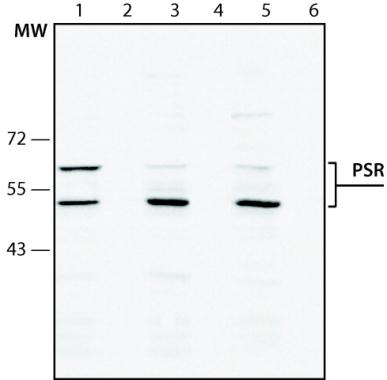
Lysates of HeLa (lanes 1-2), Jurkat (lanes 3-4) and Molt-4 (lanes 5-6) cells were separated on SDS-PAGE, blotted with Anti-PS Receptor and developed using Goat Anti-Rabbit IgG-Peroxidase and a chemiluminescent substrate. Lanes 1,3,5. Antibody 1 μg/mL 2,4,6. Antibody 1 μg/mL + PS Receptor immunizing peptide (human, 363-381)Application
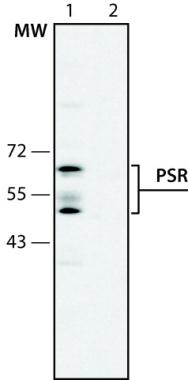
Lysate of A431 cells was separated on SDS-PAGE, blotted with Anti-PS Receptor and developed using Goat Anti-Rabbit IgG-Peroxidase and a chemiluminescent substrate. Lanes 1. Antibody 1 μg/mL 2. Antibody 1 μg/mL + PS Receptor immunizing peptide (human, 363-381)Application
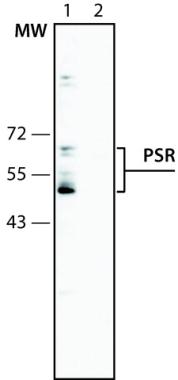
Lysate of K562 cells was separated on SDS-PAGE, blotted with Anti-PS Receptor and developed using Goat Anti-Rabbit IgG-Peroxidase and a chemiluminescent substrate. Lanes 1. Antibody 1 μg/mL 2. Antibody 1 μg/mL + PS Receptor immunizing peptide (human, 363-381)| Product Name | PSR antibody |
|---|---|
| Antibody Type | Primary Antibodies |
| Product description | Rabbit polyclonal to PSRMost cells that undergo apoptosis are rapidly recognized, engulfed, and digested by professional phagocytes or by neighboring cells and eliminated from the organism. In this way, tissue exposure to potentially cytotoxic, immunogenic, or inflammatory cellular contents is prevented. As a result neither inflammation nor inappropriate immune responses are induced in this process. Removal of apoptotic cells comprise the following steps: surface alteration and ligand expression on the apoptotic cell, ligand recognition by tethering receptors on the phagocyte, initiation of appropriate signaling pathways in the phagocyte, engulfment and finally, digestion. Various molecules including proteins, carbohydrates, and phospholipids have been suggested to act as cell surface exposed markers for recognition by phagocytes. Virtually all apoptotic cells permanently express phosphatidylserine (PS) on the outer leaflet of their plasma membrane. Such loss of phospholipids asymmetry and exposure of PS does not occur in resting cells and appears only transiently following activation of certain cells. Phosphatidylserine Receptor (PSR) has been reported and shown to recognize phosphatidylserine in a stereospecific manner. PSR is an evolutionarily conserved glycoprotein that is widely expressed in cells and tissues. It is very susceptible to cleavage by protease or elastase. PSR engagement plays an important role in macropinocytosis and uptake of tethered apoptotic cells. Cooperation with other receptors and their ligands may also be needed for ingestion of apoptotic cells. PSR is also involved in suppression of inflammatory and immune responses. |
| Immunogen | Synthetic peptide conjugated to KLH, corresponding to amino acids 363-381 of Human PSR. |
| Clonality | Polyclonal |
|---|---|
| Isotype | IgG |
| Host Species | Rabbit |
| Tested Applications | IPWB |
| IP: Use at an assay dependent dilution. WB: Use at a dilution of 1/1000 using whole extracts of human HeLa or A549 cells. Detects a band of approximately 70 kDa. Optimal dilutions/concentrations should be determined by the end user.: |
|
| Species Reactivity | HumanMouse |
| Concentration | 1mg/ml |
| Purification | Affinity purified |
| Gene Synonyms | Q6NYC1 23210 PTDSR PTDSR1 604914 PSR KIAA0585 |
|---|
Application
Lysates of HeLa (lanes 1-2), Jurkat (lanes 3-4) and Molt-4 (lanes 5-6) cells were separated on SDS-PAGE, blotted with Anti-PS Receptor and developed using Goat Anti-Rabbit IgG-Peroxidase and a chemiluminescent substrate. Lanes 1,3,5. Antibody 1 μg/mL 2,4,6. Antibody 1 μg/mL + PS Receptor immunizing peptide (human, 363-381)
Application
Lysate of A431 cells was separated on SDS-PAGE, blotted with Anti-PS Receptor and developed using Goat Anti-Rabbit IgG-Peroxidase and a chemiluminescent substrate. Lanes 1. Antibody 1 μg/mL 2. Antibody 1 μg/mL + PS Receptor immunizing peptide (human, 363-381)
Application
Lysate of K562 cells was separated on SDS-PAGE, blotted with Anti-PS Receptor and developed using Goat Anti-Rabbit IgG-Peroxidase and a chemiluminescent substrate. Lanes 1. Antibody 1 μg/mL 2. Antibody 1 μg/mL + PS Receptor immunizing peptide (human, 363-381)| Application Notes | IP: Use at an assay dependent dilution. WB: Use at a dilution of 1/1000 using whole extracts of human HeLa or A549 cells. Detects a band of approximately 70 kDa. Optimal dilutions/concentrations should be determined by the end user.: |
|---|
| Form | Liquid |
|---|---|
| Storage Instructions | Keep as concentrated solution. Aliquot and store at -20ºC or below. Avoid multiple freeze-thaw cycles. |
| Storage Buffer | Preservative: 15mM Sodium Azide; Constituents: 1% BSA, 0.01M PBS. pH 7.4 |


