Application
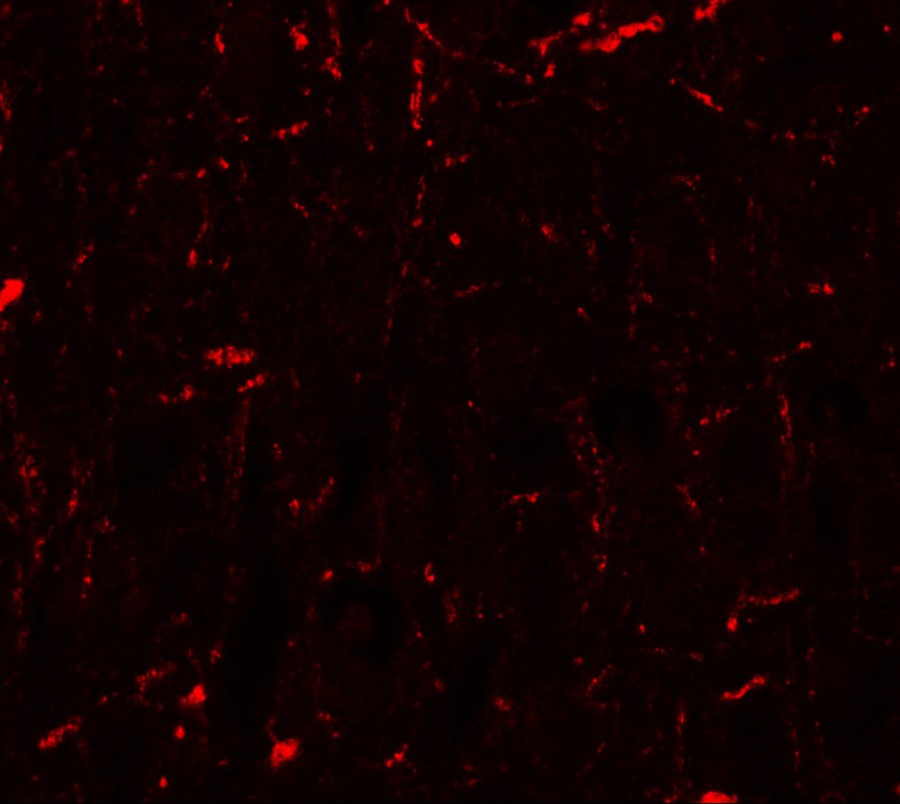
Immunofluorescence of CCNT1 in rat brain tissue with CCNT1 antibody at 20 μg/ml.| Product Name | CCNT1 Antibody |
|---|---|
| Antibody Type | Primary Antibodies |
| Antigen Alias | CCNT1 Antibody: CCNT, CYCT1, HIVE1, Cyclin-T1, CycT1 |
| Product description | CCNT1 Antibody: Cyclins function as regulators of CDK kinases and exhibit distinct expression and degradation patterns which contribute to the temporal coordination of each mitotic event. The cyclin-T1 protein (CCNT1) belongs to the highly conserved cyclin family, whose members are characterized by a dramatic periodicity in protein abundance through the cell cycle. CCNT1 tightly associates with CDK9 kinase, and was found to be a major subunit of the transcription elongation factor p-TEFb. The kinase complex containing CCNT1 and the elongation factor can interact with, and act as a cofactor of human immunodeficiency virus type 1 (HIV-1) Tat protein, and was shown to be both necessary and sufficient for full activation of viral transcription. CCNT1 and its kinase partner were also found to be involved in the phosphorylation and regulation of the carboxy-terminal domain (CTD) of the largest RNA polymerase II subunit.1) Uhlmann F, Bouchoux C, and Lopez-Aviles S. A quantitative model for cyclin-dependent kinase control of the cell cycle: revisited. Philos. Trans. R. Soc. Lond. B. biol. Sci. 2011; 366:3572-83. |
| Immunogen | Rabbit polyclonal CCNT1 antibody was raised against an 18 amino acid peptide near the carboxy terminus of human CCNT1. The immunogen is located within the last 50 amino acids of CCNT1. |
| Clonality | Polyclonal |
|---|---|
| Isotype | IgG |
| Host Species | Rabbit |
| Tested Applications | ELISAIFIHC-PWB |
| CCNT1 antibody can be used for detection of CCNT1 by Western blot at 1 - 2 μg/mL.: |
|
| Species Reactivity | HumanMouseRat |
| Concentration | 1mg/ml |
| Purification | Affinity purified |
| Gene Symbol | CCNT1 |
|---|---|
| Alternative Names | CCNT1 Antibody: CCNT CYCT1 HIVE1 Cyclin-T1 CycT1 |
| Molecular Weight(MW) | Predicted: 80 kDa |
Application
Immunofluorescence of CCNT1 in rat brain tissue with CCNT1 antibody at 20 μg/ml.| Positive Control | 1) Cat. No. 1463 - Rat Brain Tissue Lysate |
|---|---|
| Application Notes | CCNT1 antibody can be used for detection of CCNT1 by Western blot at 1 - 2 μg/mL.: |
| Form | Liquid |
|---|---|
| Storage Instructions | CCNT1 antibody can be stored at 4˚C for three months and -20˚C, stable for up to one year. |
| Storage Buffer | CCNT1 Antibody is supplied in PBS containing 0.02% sodium azide. |


