Application
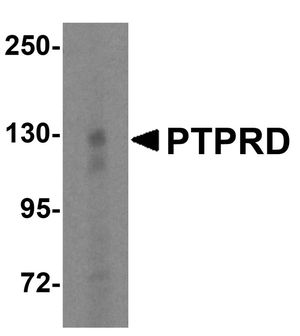
Western blot analysis of PTPRD in HeLa cell lysate with PTPRD antibody at 1 μg/mL.| Product Name | PTPRD antibody |
|---|---|
| Antibody Type | Primary Antibodies |
| Product description | Rabbit Polyclonal antibody to PTPRDThe protein encoded by this gene is a member of the protein tyrosine phosphatase (PTP) family. PTPs are known to be signaling molecules that regulate a variety of cellular processes including cell growth, differentiation, mitotic cycle, and oncogenic transformation. This PTP contains an extracellular region, a single transmembrane segment and two tandem intracytoplasmic catalytic domains, and thus represents a receptor-type PTP. The extracellular region of this protein is composed of three Ig-like and eight fibronectin type III-like domains. Studies of the similar genes in chicken and fly suggest the role of this PTP is in promoting neurite growth, and regulating neurons axon guidance. Multiple alternatively spliced transcript variants of this gene have been reported. A related pseudogene has been identified on chromosome 5. [provided by RefSeq, Jan 2010] |
| Immunogen | PTPRD antibody was raised against an 18 amino acid synthetic peptide near the amino terminus of human PTPRD. |
| Clonality | Polyclonal |
|---|---|
| Isotype | IgG |
| Host Species | Rabbit |
| Tested Applications | ELISAWB |
| WB: 1 - 2 ug/ml: |
|
| Species Reactivity | Human |
| Concentration | 1mg/ml (Please refer to the vial label for the specific concentration) |
| Purification | Affinity purified |
| Gene Synonyms | HPTPDELTA protein tyrosine phosphatase receptor type D HPTP HPTPD RPTPDELTA PTPD |
|---|---|
| Target | PTPRD |
| Tissue Specificity | PTPRD antibody is human specific. At least three alternatively spliced transcript variants encoding distinct isoforms have been observed. PTPRD cleavage products are often observed in vivo |
Application
Western blot analysis of PTPRD in HeLa cell lysate with PTPRD antibody at 1 μg/mL.| Application Notes | WB: 1 - 2 ug/ml: |
|---|
| Form | Liquid |
|---|---|
| Storage Instructions | Stored At 4ºc For Three Months And -20ºc, Stable For Up To One Year. As With All Antibodies Care Should Be Taken To Avoid Repeated Freeze Thaw Cycles. Antibodies Should Not Be Exposed To Prolonged High Temperatures. |
| Storage Buffer | PBS containing 0.02% sodium azide. |


