Application
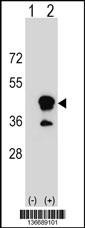
Western blot analysis of CD1B using rabbit polyclonal CD1B Antibody using 293 cell lysates (2 ug/lane) either nontransfected (Lane 1) or transiently transfected (Lane 2) with the CD1B gene.| Product Name | CD1B Antibody |
|---|---|
| Antibody Type | Primary Antibodies |
| Antigen Alias | T-cell surface glycoprotein CD1b, CD1b, CD1B |
| Product description | This gene encodes a member of the CD1 family of transmembrane glycoproteins, which are structurally related to the major histocompatibility complex (MHC) proteins and form heterodimers with beta-2-microglobulin. The CD1 proteins mediate the presentation of primarily lipid and glycolipid antigens of self or microbial origin to T cells. The human genome contains five CD1 family genes organized in a cluster on chromosome 1. The CD1 family members are thought to differ in their cellular localization and specificity for particular lipid ligands. The protein encoded by this gene localizes to late endosomes and lysosomes via a tyrosine-based motif in the cytoplasmic tail, and requires vesicular acidification to bind lipid antigens. [provided by RefSeq].1) Davila, S., et al. Genes Immun. 11(3):232-238(2010) |
| Immunogen | This CD1B antibody is generated from rabbits immunized with a KLH conjugated synthetic peptide between 57-85 amino acids from the N-terminal region of human CD1B. |
| Clonality | Polyclonal |
|---|---|
| Isotype | Ig |
| Host Species | Rabbit |
| Tested Applications | WB |
| For WB starting dilution is: 1:1000: |
|
| Species Reactivity | Human |
| Concentration | 1mg/ml |
| Purification | Affinity purified |
| Gene Symbol | CD1B |
|---|---|
| Alternative Names | T-cell surface glycoprotein CD1b CD1b CD1B |
| Molecular Weight(MW) | 37 kDa |
Application
Western blot analysis of CD1B using rabbit polyclonal CD1B Antibody using 293 cell lysates (2 ug/lane) either nontransfected (Lane 1) or transiently transfected (Lane 2) with the CD1B gene.| Application Notes | For WB starting dilution is: 1:1000: |
|---|
| Form | Liquid |
|---|---|
| Storage Instructions | Store at 4˚C for three months and -20˚C, stable for up to one year. As with all antibodies care should be taken to avoid repeated freeze thaw cycles. Antibodies should not be exposed to prolonged high temperatures. |
| Storage Buffer | Supplied in PBS with 0.09% (W/V) sodium azide. |


