Application
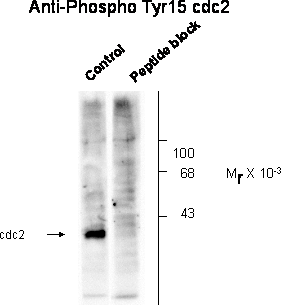
Western blot of human T47D cells showing phospho-specific immunolabeling of the ~34k cdc2 protein phosphorylated at Tyr15. In lane 2, cells were treated with EGF leading to dephosphorylation of Tyr15.| Product Name | Cdc2 (phospho Tyr15) Antibody |
|---|---|
| Antibody Type | Primary Antibodies |
| Antigen Alias | LOC365842, CDC-like kinase 2, Protein Clk2 |
| Product description | Cdc2 is a highly conserved protein serine kinase that plays a key role in regulation of the cell cycle. The ability of cdc2 to exercise control over the cell cycle is dependent upon the phosphorylation of Tyr15 in cdc2.1) Sible, J.C., "Cell biology: thanks for the memory," Nature (London), 426 (2003) 392-393. |
| Immunogen | Cdc2 (Tyr15) polyclonal antibody was raised against a synthetic phosphopeptide corresponding to amino acid residues surrounding the phosphorylated-Tyr15 of human, mouse, rat and xenopus cdc2. |
| Modification | p-Tyr15 |
| Clonality | Polyclonal |
|---|---|
| Host Species | Rabbit |
| Tested Applications | WB |
| The antibody is purified by sequential chromatography on phospho- and non-phosphopeptide affinity columns. Antibody dilutions and tissue load should be based on tissue type and expected phosphorylation state. Western blots of SK-N-MC total cell extracts with phospho- and non-phosphopeptide competition were used to establish the phospho-specificity of the antibody. Immunolabeling of the Mr 34 kDa cdc2 protein is blocked by the Ser15 phosphopeptide used as antigen but not by the corresponding non-phosphopeptide. Initial recommended range of dilutions: 1:500 to 1:2000. Applications include Dot Blots (DB) and Western Blot (WB). Suitability for Immunohistochemistry (IHC) has not been determined. Drosophila, human, mouse, rat and Xenopus have 100% amino acid sequence identity with the antigen used to raise the antibody. When internally tested under ideal conditions the working dilutions were 1:1000 for DB and WB.: |
|
| Species Reactivity | DogHumanMouseRatXenopus |
| Concentration | 1mg/ml |
| Purification | Affinity purified |
| Gene Symbol | Clk2 |
|---|---|
| Alternative Names | LOC365842 CDC-like kinase 2 Protein Clk2 |
| Molecular Weight(MW) | 34 |
| Tissue Specificity | Cdc2 antibody is specific for cdc2 phosphorylated at Tyr15. |
Application
Western blot of human T47D cells showing phospho-specific immunolabeling of the ~34k cdc2 protein phosphorylated at Tyr15. In lane 2, cells were treated with EGF leading to dephosphorylation of Tyr15.| Application Notes | The antibody is purified by sequential chromatography on phospho- and non-phosphopeptide affinity columns. Antibody dilutions and tissue load should be based on tissue type and expected phosphorylation state. Western blots of SK-N-MC total cell extracts with phospho- and non-phosphopeptide competition were used to establish the phospho-specificity of the antibody. Immunolabeling of the Mr 34 kDa cdc2 protein is blocked by the Ser15 phosphopeptide used as antigen but not by the corresponding non-phosphopeptide. Initial recommended range of dilutions: 1:500 to 1:2000. Applications include Dot Blots (DB) and Western Blot (WB). Suitability for Immunohistochemistry (IHC) has not been determined. Drosophila, human, mouse, rat and Xenopus have 100% amino acid sequence identity with the antigen used to raise the antibody. When internally tested under ideal conditions the working dilutions were 1:1000 for DB and WB.: |
|---|
| Form | Liquid |
|---|---|
| Storage Instructions | For long term storage –80˚C is recommended, but shorter term storage at –20˚C is also acceptable as aliquots may be taken without freeze/thawing due to the presence of 50% glycerol. Stable for one year. |
| Storage Buffer | 100 uL in 10 mM HEPES (pH 7.5), 150 mM NaCl, 100 ug per mL BSA and 50% glycerol. |


