Application
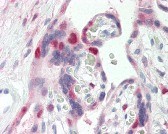
Immunohistochemistry staining of CDK2 in placenta tissue using CDK2 Monoclonal Antibody.| Product Name | CDK2 Antibody, Monoclonal |
|---|---|
| Antibody Type | Primary Antibodies |
| Antigen Alias | CDK2, CDC2, Cell devision kinase 2, Cell division protein kinase 2, CDC2-related protein kinase, Cell division kinase 2, p33 protein kinase, p33(CDK2), CDKN2, Cyclin-dependent kinase 2 |
| Product description | p33cdk2 associates with cyclin A in human cells. Kinase activity associated with cyclin A-cdc2 is found only in G2-phase. Cdk2 also complexes with cyclins E, D1, and D3. Cyclin Ecdk2 kinase is active in the G1- and S-phases of the cell cycle and is important (as does cyclin A-cdk2) for the progression from G1-to S-phase. The levels of cyclin A-cdk2 is maximal at the G1/S transition and both cdk2 and cyclin A are found associated with DNA in the initiation complex during replication. Rb protein acts as substrate for cdk2-cyclin E and/or cdk2-cyclin A in vivo. Cdk2 is activated and specifically localized to the nucleus during late G1-, S-, and G2-phase. Immunofluorescence Immunoprecipitation (Denatured only) (Use Protein A) (Ab 2ug/mg protein lysate) Western Blot (Ab 1-2 μg/mL for 2hrs at RT) Positive Control HeLa cells Cellular Localization Cytoplasmic and nuclear Recognizes Cdk2. Species Crossreactivity: Human, Mouse, and Rat. Cyclin-dependent kinase 2 (CDK2), a CDC2/CDK-type protein kinase, regulates cell-cycle transition from G1 to S phase. CDK2 activation requires formation of a heterodimer with cyclin A, D, or E and phosphorylation by CAK. CDK2 inhibition results from association with p21Cip1 (CDKN1A) and p27Kip1 (CDKN1B). Two alternatively spliced variants and multiple transcription initiation sites have been reported. Inhibition of CDK2 has been suggested to help prevent chemotherapy-induced alopecia in cancer patients. |
| Immunogen | CDK2 monoclonal antibody was raised against recombinant CDK2 (Human). |
| Clonality | Monoclonal |
|---|---|
| Isotype | IgG2,k |
| Host Species | Mouse |
| Tested Applications | ELISAIFIHCIPWB |
| CDK2 antibody can be used in immunohistochemistry starting at 2.5 μg/mL.: |
|
| Species Reactivity | HumanMouseRat |
| Concentration | 1mg/ml |
| Purification | Protein A |
| Gene Symbol | CDK2 |
|---|---|
| Alternative Names | CDK2 CDC2 Cell devision kinase 2 Cell division protein kinase 2 CDC2-related protein kinase Cell division kinase 2 p33 protein kinase p33(CDK2) CDKN2 Cyclin-dependent kinase 2 |
Application
Immunohistochemistry staining of CDK2 in placenta tissue using CDK2 Monoclonal Antibody.| Application Notes | CDK2 antibody can be used in immunohistochemistry starting at 2.5 μg/mL.: |
|---|
| Form | Liquid |
|---|---|
| Storage Instructions | Store CDK2 antibody at 4 ˚C or -20 ˚C. As with all antibodies avoid freeze/thaw cycles. |
| Storage Buffer | 10mM PBS, pH 7.4, 0.2% BSA, 0.09% sodium azide, before the addition of glycerol to 40% |


