Application
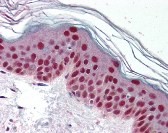
Immunohistochemistry staining of CDK9 in skin tissue using CDK9 Antibody.| Product Name | CDK9 Antibody |
|---|---|
| Antibody Type | Primary Antibodies |
| Antigen Alias | CDK9, C-2k, CDC2L4, CDC2-related kinase, Cell division protein kinase 9, Cyclin-dependent kinase 9, CDC2-related protein kinase, PITALRE, TAK, CTK1 |
| Product description | CDK9 (PITALRE) (also known as cyclin-dependent kinase 9, Serine/threonine-protein kinase PITALRE, C-2K and Cell division cycle 2-like protein kinase 4) is a member of the cyclin-dependent protein kinase (CDK) family. CDK family members are highly similar to the gene products of S. cerevisiae cdc28, and S. pombe cdc2, and known as important cell cycle regulators. CDK9 (PITALRE) interacts with a conserved domain in the TRAF-C region of the tumor necrosis factor signal transducer TRAF2. This kinase also was found to be a component of the multiprotein complex TAK/P-TEFb, which is an elongation factor for RNA polymerase II-directed transcription and functions by phosphorylating the C-terminal domain of the largest subunit of RNA polymerase II. This protein forms a complex with and is regulated by its regulatory subunit cyclin T or cyclin K. HIV-1 Tat protein was found to interact with this protein and cyclin T, which suggested a possible involvement of this protein in AIDS. Tat stimulates human HIV-1 viral transcription elongation. This suggests that cyclin T1/cdk9(PITALRE) is one of the HIV-1 required host cellular cofactors generated during T cell activation. Cyclin T1/cdk9(PITALRE) is shown to interact with Tat to restore Tat activation in HeLa nuclear extracts depleted of P-TEFb. The cdk9(PITALRE) activity and cyclin T1 are essential for activation of transcription when tethered to the heterologous Rev response element RNA via the regulator of expression of virion Rev. CDK9 (PITALRE) is a ubiquitously expressed nuclear protein. |
| Immunogen | CDK9 antibody was raised against multiple synthetic peptides corresponding to C-Terminus of CDK9 (Human). |
| Clonality | Polyclonal |
|---|---|
| Host Species | Rabbit |
| Tested Applications | ELISAIHCIPWB |
| CDK9 antibody can be used in Western Blot, and immunohistochemistry starting at 2.5 μg/mL.: |
|
| Species Reactivity | HumanMouseRat |
| Concentration | 1mg/ml |
| Purification | Affinity purified |
| Gene Symbol | CDK9 |
|---|---|
| Alternative Names | CDK9 C-2k CDC2L4 CDC2-related kinase Cell division protein kinase 9 Cyclin-dependent kinase 9 CDC2-related protein kinase PITALRE TAK CTK1 |
Application
Immunohistochemistry staining of CDK9 in skin tissue using CDK9 Antibody.| Application Notes | CDK9 antibody can be used in Western Blot, and immunohistochemistry starting at 2.5 μg/mL.: |
|---|
| Form | Liquid |
|---|---|
| Storage Instructions | Store CDK9 antibody at -20 ˚C or below prior to opening. Dilute only prior to immediate use. Aliquot contents and freeze at -20 ˚C or below. As with all antibodies avoid freeze/thaw cycles. |
| Storage Buffer | 0.02 M potassium phosphate, 0.15 M sodium chloride, pH 7.2, 0.01% sodium azide. |


