Application
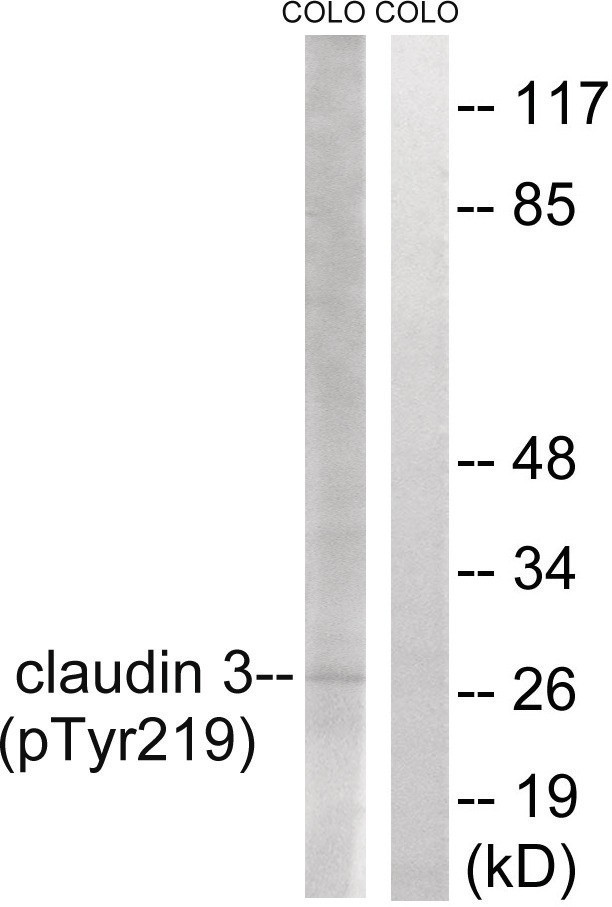
Western blot analysis of extracts from COLO cells treated with EGF using Claudin 3 (Phospho-Tyr219) Antibody. The lane on the right is treated with the antigen-specific peptide.| Product Name | Claudin 3 (phospho Tyr219) Antibody |
|---|---|
| Antibody Type | Primary Antibodies |
| Antigen Alias | CLD3, CLDN3, HRVP1, CPE-R 2, CPE-receptor 2 |
| Product description | Tight junctions represent one mode of cell-to-cell adhesion in epithelial or endothelial cell sheets, forming continuous seals around cells and serving as a physical barrier to prevent solutes and water from passing freely through the paracellular space. These junctions are comprised of sets of continuous networking strands in the outwardly facing cytoplasmic leaflet, with complementary grooves in the inwardly facing extracytoplasmic leaflet. The protein encoded by this intronless gene, a member of the claudin family, is an integral membrane protein and a component of tight junction strands.1) Peacock R.E., Genomics 46:443-449(1997). |
| Immunogen | Claudin 3 (phospho Tyr219) antibody was raised against a peptide sequence around phosphorylation site of tyrosine 219 (R-K-D-Y (p)-V) derived from Human Claudin 3. |
| Modification | p-Tyr219 |
| Clonality | Polyclonal |
|---|---|
| Isotype | IgG |
| Host Species | Rabbit |
| Tested Applications | WB |
| Western Blot: 1:500~1:1000: |
|
| Species Reactivity | Human |
| Concentration | 1mg/ml |
| Purification | Affinity purified |
| Gene Symbol | CLDN3 |
|---|---|
| Alternative Names | CLD3 CLDN3 HRVP1 CPE-R 2 CPE-receptor 2 |
| Molecular Weight(MW) | 28 kDa |
| Tissue Specificity | The antibody detects endogenous levels of Claudin 3 only when phosphorylated at tyrosine 219. |
| Entrez Gene | 1365 |
|---|---|
| Protein Accession | NP_001297.1 |
Application
Western blot analysis of extracts from COLO cells treated with EGF using Claudin 3 (Phospho-Tyr219) Antibody. The lane on the right is treated with the antigen-specific peptide.| Application Notes | Western Blot: 1:500~1:1000: |
|---|
| Form | Liquid |
|---|---|
| Storage Instructions | Store antibody at -20˚C for up to one year. |
| Storage Buffer | Antibody supplied in phosphate buffered saline (without Mg2+ and Ca2+), pH 7.4, 150mM NaCl, 0.02% sodium azide and 50% glycerol. |


