Application
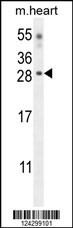
Western blot analysis in mouse heart tissue lysates (35ug/lane).| Product Name | CLDN6 Antibody |
|---|---|
| Antibody Type | Primary Antibodies |
| Antigen Alias | Claudin-6, Skullin, CLDN6 |
| Product description | Tight junctions represent one mode of cell-to-cell adhesion in epithelial or endothelial cell sheets, forming continuous seals around cells and serving as a physical barrier to prevent solutes and water from passing freely through the paracellular space. These junctions are comprised of sets of continuous networking strands in the outwardly facing cytoplasmic leaflet, with complementary grooves in the inwardly facing extracytoplasmic leaflet. This gene encodes a component of tight junction strands, which is a member of the claudin family. The protein is an integral membrane protein and is one of the entry cofactors for hepatitis C virus. The gene methylation may be involved in esophageal tumorigenesis. This gene is adjacent to another family member CLDN9 on chromosome 16.1) Wu, Q., et al. Eur. J. Cancer Prev. 19(3):186-194(2010) |
| Immunogen | This CLDN6 antibody is generated from rabbits immunized with a KLH conjugated synthetic peptide between 130-159 amino acids from the Central region of human CLDN6. |
| Clonality | Polyclonal |
|---|---|
| Isotype | Ig |
| Host Species | Rabbit |
| Tested Applications | WB |
| For WB starting dilution is: 1:1000: |
|
| Species Reactivity | HumanMouse |
| Concentration | 1mg/ml |
| Purification | Affinity purified |
| Gene Symbol | CLDN6 |
|---|---|
| Alternative Names | Claudin-6 Skullin CLDN6 |
| Molecular Weight(MW) | 23 kDa |
| Sequence Similarities | Predicted species reactivity based on immunogen sequence: Zebrafish |
Application
Western blot analysis in mouse heart tissue lysates (35ug/lane).| Application Notes | For WB starting dilution is: 1:1000: |
|---|
| Form | Liquid |
|---|---|
| Storage Instructions | Store at 4˚C for three months and -20˚C, stable for up to one year. As with all antibodies care should be taken to avoid repeated freeze thaw cycles. Antibodies should not be exposed to prolonged high temperatures. |
| Storage Buffer | Supplied in PBS with 0.09% (W/V) sodium azide. |


