Application
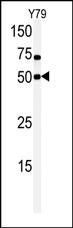
Western blot analysis of anti-hCLK1-C84 Pab in Y79 cell line lysate.| Product Name | CLK1 Antibody |
|---|---|
| Antibody Type | Primary Antibodies |
| Antigen Alias | Dual specificity protein kinase CLK1, CDC-like kinase 1, CLK1, CLK |
| Product description | This gene encodes a member of the CDC2-like (or LAMMER) family of dual specificity protein kinases. In the nucleus, the encoded protein phosphorylates serine/arginine-rich proteins involved in pre-mRNA processing, releasing them into the nucleoplasm. The choice of splice sites during pre-mRNA processing may be regulated by the concentration of transacting factors, including serine/arginine rich proteins. Therefore, the encoded protein may play an indirect role in governing splice site selection.1) Prasad, J., et al., Mol. Cell. Biol. 23(12):4139-4149 (2003). Talmadge, C.B., et al., Hum. Genet. 103(4):523-524 (1998). Hanes, J., et al., J. Mol. Biol. 244(5):665-672 (1994). Johnson, K.W., et al., J. Biol. Chem. 266(6):3402-3407 (1991). Ben-David, Y., et al., EMBO J. 10(2):317-325 (1991). |
| Immunogen | This CLK1 antibody is generated from rabbits immunized with a KLH conjugated synthetic peptide between 70-99 amino acids from the N-terminal region of human CLK1. |
| Clonality | Polyclonal |
|---|---|
| Isotype | Ig |
| Host Species | Rabbit |
| Tested Applications | WB |
| For WB starting dilution is: 1:1000: |
|
| Species Reactivity | Human |
| Concentration | 1mg/ml |
| Gene Symbol | CLK1 |
|---|---|
| Alternative Names | Dual specificity protein kinase CLK1 CDC-like kinase 1 CLK1 CLK |
| Molecular Weight(MW) | 57 kDa |
Application
Western blot analysis of anti-hCLK1-C84 Pab in Y79 cell line lysate.| Application Notes | For WB starting dilution is: 1:1000: |
|---|
| Form | Liquid |
|---|---|
| Storage Instructions | Store at 4˚C for three months and -20˚C, stable for up to one year. As with all antibodies care should be taken to avoid repeated freeze thaw cycles. Antibodies should not be exposed to prolonged high temperatures. |
| Storage Buffer | Supplied in PBS with 0.09% (W/V) sodium azide. |


