Application
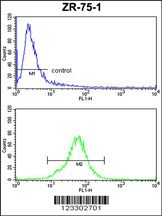
Flow cytometric analysis of ZR-75-1 cells (bottom histogram) compared to a negative control cell (top histogram). FITC-conjugated goat-anti-rabbit secondary antibodies were used for the analysis.| Product Name | COQ3 Antibody |
|---|---|
| Antibody Type | Primary Antibodies |
| Antigen Alias | Hexaprenyldihydroxybenzoate methyltransferase, mitochondrial, 2-polyprenyl-6-hydroxyphenol methylase,4-dihydroxy-5-hexaprenylbenzoate methyltransferase, DHHB methyltransferase, DHHB-MT, DHHB-MTase, 3-demethylubiquinone-10 3-methyltransferase, Dihydroxyhexa |
| Product description | Ubiquinone, also known as coenzyme Q, or Q, is a critical component of the electron transport pathways of both eukaryotes and prokaryotes (Jonassen and Clarke, 2000 [PubMed 10777520]). This lipid consists of a hydrophobic isoprenoid tail and a quinone head group. The tail varies in length depending on the organism, but its purpose is to anchor coenzyme Q to the membrane. The quinone head group is responsible for the activity of coenzyme Q in the respiratory chain. COQ3 is an O-methyltransferase required for 2 steps in the biosynthetic pathway of coenzyme Q. This enzyme methylates an early coenzyme Q intermediate, 3,4-dihydroxy-5-polyprenylbenzoic acid, as well as the final intermediate in the pathway, converting demethyl-ubiquinone to coenzyme Q. The COQ3 is also capable of methylating the distinct prokaryotic early intermediate 2-hydroxy-6-polyprenyl phenol.1) Olsen,J.V., et.al., Cell 127 (3), 635-648 (2006) |
| Immunogen | This COQ3 antibody is generated from rabbits immunized with a KLH conjugated synthetic peptide between 172-201 amino acids from the Central region of human COQ3. |
| Clonality | Polyclonal |
|---|---|
| Isotype | Ig |
| Host Species | Rabbit |
| Tested Applications | IHC-PWB |
| For WB starting dilution is: 1:1000 For IHC-P starting dilution is: 1:50~100 For FACS starting dilution is: 1:10~50: |
|
| Species Reactivity | Human |
| Concentration | 1mg/ml |
| Purification | Affinity purified |
| Gene Symbol | COQ3 |
|---|---|
| Alternative Names | Hexaprenyldihydroxybenzoate methyltransferase mitochondrial 2-polyprenyl-6-hydroxyphenol methylase 4-dihydroxy-5-hexaprenylbenzoate methyltransferase DHHB methyltransferase DHHB-MT DHHB-MTase 3-demethylubiquinone-10 3-methyltransferase Dihydroxyhexa |
| Molecular Weight(MW) | 41 kDa |
| Sequence Similarities | Predicted species reactivity based on immunogen sequence: Bovine |
Application
Flow cytometric analysis of ZR-75-1 cells (bottom histogram) compared to a negative control cell (top histogram). FITC-conjugated goat-anti-rabbit secondary antibodies were used for the analysis.| Application Notes | For WB starting dilution is: 1:1000 For IHC-P starting dilution is: 1:50~100 For FACS starting dilution is: 1:10~50: |
|---|
| Form | Liquid |
|---|---|
| Storage Instructions | Store at 4˚C for three months and -20˚C, stable for up to one year. As with all antibodies care should be taken to avoid repeated freeze thaw cycles. Antibodies should not be exposed to prolonged high temperatures. |
| Storage Buffer | Supplied in PBS with 0.09% (W/V) sodium azide. |


