Application
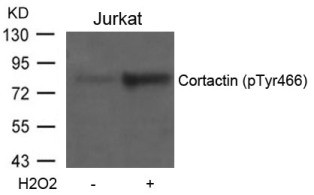
Western blot analysis of lysed extracts from Jurkat cells untreated or treated with H2O2 using Cortactin (Phospho-Tyr466).| Product Name | Cortactin (phospho Tyr466) Antibody |
|---|---|
| Antibody Type | Primary Antibodies |
| Antigen Alias | EMS1, PKB, RAC, Amplaxin, CTTN, EMS1, SRC8 |
| Product description | Cortactin is overexpressed in breast cancer and squamous cell carcinomas of the head and neck. The encoded protein is localized in the cytoplasm and in areas of the cell-substratum contacts. This gene has two roles: (1) regulating the interactions between components of adherens-type junctions and (2) organizing the cytoskeleton and cell adhesion structures of epithelia and carcinoma cells. During apoptosis, the encoded protein is degraded in a caspase-dependent manner. The aberrant regulation of this gene contributes to tumor cell invasion and metastasis. Two splice variants that encode different isoforms have been identified for this gene.1) Luo C, et al. (2006) J Biol Chem ; 281 (40): 30081-30093Head JA, et al. (2003) Mol Biol Cell ;14 (8): 3216-3229Li Y, et al. (2000) J Biol Chem ; 275 (47): 37187-37193Kinley AW, et al. (2003) Curr Biol ; 13 (5): 384-393 |
| Immunogen | Cortactin (Phospho-Tyr466) antibody was raised against a peptide sequence around phosphorylation site of tyrosine 466 (P-V-Y (p) -E-T) derived from Human CORTACTIN. |
| Modification | p-Tyr466 |
| Clonality | Polyclonal |
|---|---|
| Host Species | Rabbit |
| Tested Applications | WB |
| Western Blot: 1:500~1:1000: |
|
| Species Reactivity | HumanMouse |
| Concentration | 1mg/ml |
| Purification | Affinity purified |
| Gene Symbol | CTTN |
|---|---|
| Alternative Names | EMS1 PKB RAC Amplaxin CTTN EMS1 SRC8 |
| Molecular Weight(MW) | 85 kDa |
| Tissue Specificity | This antibody detects endogenous level of Cortactin only when phosphorylated at tyrosine 466. |
| Entrez Gene | 2017 |
|---|---|
| Protein Accession | NP_005222.2 |
Application
Western blot analysis of lysed extracts from Jurkat cells untreated or treated with H2O2 using Cortactin (Phospho-Tyr466).| Application Notes | Western Blot: 1:500~1:1000: |
|---|
| Form | Liquid |
|---|---|
| Storage Instructions | Store antibody at -20˚C for up to one year. |
| Storage Buffer | Antibody supplied in phosphate buffered saline (without Mg2+ and Ca2+), pH 7.4, 150mM NaCl, 0.02% sodium azide and 50% glycerol. |


