Application
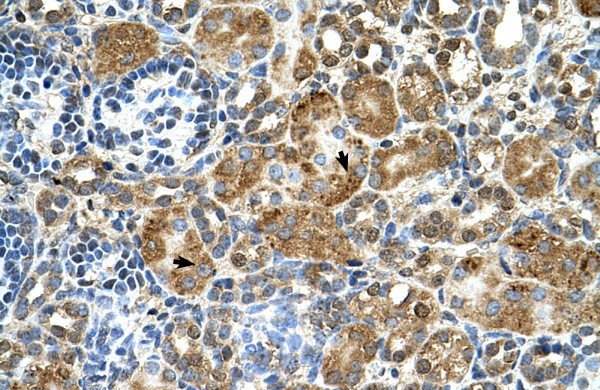
Antibody used in IHC on Human kidney.Application
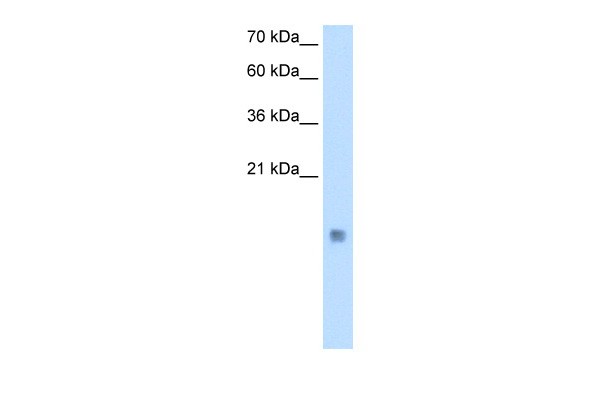
Antibody used in WB on Transfected 293T at 0.25 ug/ml.| Product Name | CSTB Antibody |
|---|---|
| Antibody Type | Primary Antibodies |
| Product description | CSTB is a stefin that functions as an intracellular thiol protease inhibitor. The protein is able to form a dimer stabilized by noncovalent forces, inhibiting papain and cathepsins l, h and b. The protein is thought to play a role in protecting against the proteases leaking from lysosomes. Evidence indicates that mutations in CSTB gene are responsible for the primary defects in patients with progressive myoclonic epilepsy a stefin that functions as an intracellular thiol protease inhibitor. The protein is able to form a dimer stabilized by noncovalent forces, inhibiting papain and cathepsins l, h and b. The protein is thought to play a role in protecting against the proteases leaking from lysosomes. Evidence indicates that mutations in this gene are responsible for the primary defects in patients with progressive myoclonic epilepsy.The cystatin superfamily encompasses proteins that contain multiple cystatin-like sequences. Some of the members are active cysteine protease inhibitors, while others have lost or perhaps never acquired this inhibitory activity. There are three inhibitory families in the superfamily, including the type 1 cystatins (stefins), type 2 cystatins and kininogens. This gene encodes a stefin that functions as an intracellular thiol protease inhibitor. The protein is able to form a dimer stabilized by noncovalent forces, inhibiting papain and cathepsins l, h and b. The protein is thought to play a role in protecting against the proteases leaking from lysosomes. Evidence indicates that mutations in this gene are responsible for the primary defects in patients with progressive myoclonic epilepsy (EPM1).1) Kenig, M., (2006) Proteins 62 (4), 918-927. |
| Immunogen | Antibody produced in rabbits immunized with a synthetic peptide corresponding a region of human CSTB. |
| Clonality | Polyclonal |
|---|---|
| Host Species | Rabbit |
| Tested Applications | ELISAIHCWB |
| CSTB antibody can be used for detection of CSTB by ELISA at 1:12500. CSTB antibody can be used for detection of CSTB by western blot at 0.25 μg/mL, and HRP conjugated secondary antibody should be diluted 1:50,000 - 100,000. | |
| Species Reactivity | Human |
| Concentration | 1mg/ml |
| Purification | Affinity purified |
| Gene Symbol | CSTB |
|---|---|
| Alternative Names | CSTB CST6 EPM1 PME STFB ULD EPM1A |
| Molecular Weight(MW) | 11 kDa |
Application
Antibody used in IHC on Human kidney.
Application
Antibody used in WB on Transfected 293T at 0.25 ug/ml.| Positive Control | 1) Tranfected 293T Cell Lysate |
|---|---|
| Application Notes | CSTB antibody can be used for detection of CSTB by ELISA at 1:12500. CSTB antibody can be used for detection of CSTB by western blot at 0.25 μg/mL, and HRP conjugated secondary antibody should be diluted 1:50,000 - 100,000. |
| Form | Liquid |
|---|---|
| Storage Instructions | For short periods of storage (days) store at 4˚C. For longer periods of storage, store CSTB antibody at -20˚C. As with any antibody avoid repeat freeze-thaw cycles. |
| Storage Buffer | Antibody is lyophilized in PBS buffer with 2% sucrose. Add 50 μL of distilled water. Final antibody concentration is 1 mg/mL. |


