Application
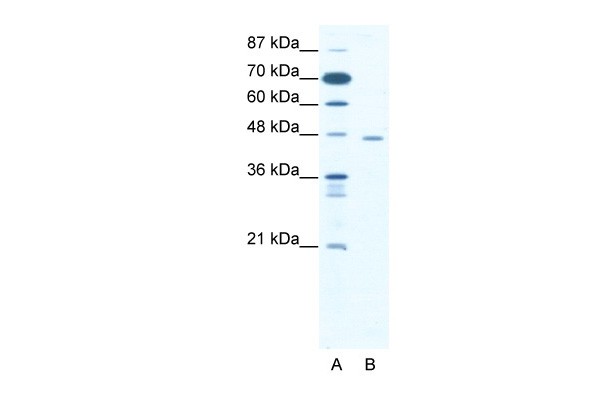
Antibody used in WB on Human Jurkat cells at 1.25 ug/ml.| Product Name | CTBP1 Antibody |
|---|---|
| Antibody Type | Primary Antibodies |
| Product description | CTBP1 binds to the C-terminus of adenovirus E1A proteins. This phosphoprotein is a transcriptional repressor and may play a role during cellular proliferation. This protein and the product of a second closely related gene, CTBP2, can dimerize. Both proteins can also interact with a polycomb group protein complex which participates in regulation of gene expression during development. Alternative splicing of transcripts from this gene results in multiple transcript variants.1) Spyer, M., et al., (2006) Cell Cycle 5 (5), 530-537. |
| Immunogen | Antibody produced in rabbits immunized with a synthetic peptide corresponding a region of human CTBP1. |
| Clonality | Polyclonal |
|---|---|
| Host Species | Rabbit |
| Tested Applications | ELISAWB |
| CTBP1 antibody can be used for detection of CTBP1 by ELISA at 1:62500. CTBP1 antibody can be used for detection of CTBP1 by western blot at 1.25 μg/mL, and HRP conjugated secondary antibody should be diluted 1:50,000 - 100,000. | |
| Species Reactivity | Human |
| Concentration | 1mg/ml |
| Purification | Protein A |
| Gene Symbol | CTBP1 |
|---|---|
| Alternative Names | CTBP1 BARS |
| Molecular Weight(MW) | 47 kDa, 48 kDa |
| Entrez Gene | 1487 |
|---|---|
| Protein Accession | NP_001012632 |
Application
Antibody used in WB on Human Jurkat cells at 1.25 ug/ml.| Positive Control | 1) Cat. No. 1205 - Jurkat Cell Lysate |
|---|---|
| Application Notes | CTBP1 antibody can be used for detection of CTBP1 by ELISA at 1:62500. CTBP1 antibody can be used for detection of CTBP1 by western blot at 1.25 μg/mL, and HRP conjugated secondary antibody should be diluted 1:50,000 - 100,000. |
| Form | Liquid |
|---|---|
| Storage Instructions | For short periods of storage (days) store at 4˚C. For longer periods of storage, store CTBP1 antibody at -20˚C. As with any antibody avoid repeat freeze-thaw cycles. |
| Storage Buffer | IgG in phosphate buffered saline , pH 7.4, 150mM NaCl, 0.02% sodium azide and 50% glycerol.Store at -20 °C.Stable for 12 months from date of receipt |


