Application
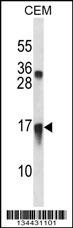
Western blot analysis in CEM cell line lysates (35ug/lane).| Product Name | CXCL11 Antibody |
|---|---|
| Antibody Type | Primary Antibodies |
| Product description | Chemokines are a group of small (approximately 8 to 14 kD), mostly basic, structurally related molecules that regulate cell trafficking of various types of leukocytes through interactions with a subset of 7-transmembrane, G protein-coupled receptors. Chemokines also play fundamental roles in the development, homeostasis, and function of the immune system, and they have effects on cells of the central nervous system as well as on endothelial cells involved in angiogenesis or angiostasis. Chemokines are divided into 2 major subfamilies, CXC and CC. This gene is a CXC member of the chemokine superfamily. Its encoded protein induces a chemotactic response in activated T-cells and is the dominant ligand for CXC receptor-3. The gene encoding this protein contains 4 exons and at least three polyadenylation signals which might reflect cell-specific regulation of expression. IFN-gamma is a potent inducer of transcription of this gene.1) Rot, A. Front. Biosci. 15, 645-660 (2010) : |
| Immunogen | This CXCL11 antibody is generated from rabbits immunized with a KLH conjugated synthetic peptide between 64-93 amino acids from the C-terminal region of human CXCL11. |
| Clonality | Polyclonal |
|---|---|
| Isotype | Ig |
| Host Species | Rabbit |
| Tested Applications | WB |
| For WB starting dilution is: 1:1000 | |
| Species Reactivity | Human |
| Concentration | 1mg/ml |
| Purification | Affinity purified |
| Gene Symbol | CXCL11 |
|---|---|
| Alternative Names | C-X-C motif chemokine 11 Beta-R1 H174 Interferon gamma-inducible protein 9 IP-9 Interferon-inducible T-cell alpha chemoattractant I-TAC Small-inducible cytokine B11 CXCL11 ITAC SCYB11 SCYB9B |
| Molecular Weight(MW) | 10 kDa |
Application
Western blot analysis in CEM cell line lysates (35ug/lane).| Application Notes | For WB starting dilution is: 1:1000 |
|---|
| Form | Liquid |
|---|---|
| Storage Instructions | Store at 4˚C for three months and -20˚C, stable for up to one year. As with all antibodies care should be taken to avoid repeated freeze thaw cycles. Antibodies should not be exposed to prolonged high temperatures. |
| Storage Buffer | Supplied in PBS with 0.09% (W/V) sodium azide. |


