Application
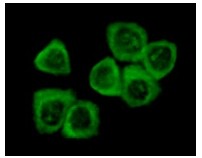
Innunofluorescense staining of methanol - fixed Gc - 7901 cells showing cytoplasm localization.Application
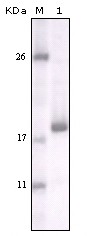
Western blot analysis using DDR2 monoclonal antibody against truncated DDR2 - Trx recombinant protein.| Product Name | DDR2 Antibody |
|---|---|
| Antibody Type | Primary Antibodies |
| Antigen Alias | NTRKR3, TKT, TYRO10, CD167 antigen-like family member B, Discoidin domain receptor 2, MIG20a, NTRKR3 |
| Product description | DDR2 (discoidin domain receptor family, member 2) is one of the largest families of proteins in eukaryotes. The family has been classified in 8 major groups based on sequence comparison of their tyrosine (PTK) or serine/ threonine (STK) kinase catalytic domains. Receptor tyrosine kinases (RTKs) play a key role in the communication of cells with their microenvironment. These molecules are involved in the regulation of cell growth, differentiation, and metabolism. In several cases the biochemical mechanism by which RTKs transduce signals across the membrane has been shown to be ligand induced receptor oligomerization and subsequent intracellular phosphorylation. This autophosphorylation leads to phosphorylation of cytosolic targets as well as association with other molecules, which are involved in pleiotropic effects of signal transduction. RTKs have a tripartite structure with extracellular, transmembrane, and cytoplasmic regions. This gene encodes a member of a novel subclass of RTKs and contains a distinct extracellular region encompassing a factor VIII-like domain. Alternative splicing in the 5' UTR results in multiple transcript variants encoding the same protein.1) Leitinger B. Kwan AP. Matrix Biol. 2006, Aug, 25(6):355-64. Epub 2006 May 26. |
| Immunogen | Ni-NTA purified truncated recombinant DDR2-Trx expressed in E. Coli strain BL21 (DE3). |
| Clonality | Monoclonal |
|---|---|
| Isotype | IgG2a |
| Host Species | Mouse |
| Tested Applications | ELISAIHCWB |
| Western Blot:1:500 - 1:2,000 IHC(P):1:500 - 1:2,000 ELISA:Propose dilution 1:10,000. Determining optimal working dilutions by titration test.: |
|
| Species Reactivity | Human |
| Concentration | 1mg/ml |
| Gene Symbol | DDR2 |
|---|---|
| Alternative Names | NTRKR3 TKT TYRO10 CD167 antigen-like family member B Discoidin domain receptor 2 MIG20a NTRKR3 |
Application
Innunofluorescense staining of methanol - fixed Gc - 7901 cells showing cytoplasm localization.
Application
Western blot analysis using DDR2 monoclonal antibody against truncated DDR2 - Trx recombinant protein.| Application Notes | Western Blot:1:500 - 1:2,000 IHC(P):1:500 - 1:2,000 ELISA:Propose dilution 1:10,000. Determining optimal working dilutions by titration test.: |
|---|
| Form | Liquid |
|---|---|
| Storage Instructions | DDR2 monoclonal antibody can be stored at -20˚C, stable for one year. As with all antibodies care should be taken to avoid repeated freeze thaw cycles. Antibodies should not be exposed to prolonged high temperatures. |
| Storage Buffer | Ascitic fluid containing 0.03% sodium azide. |


