Application
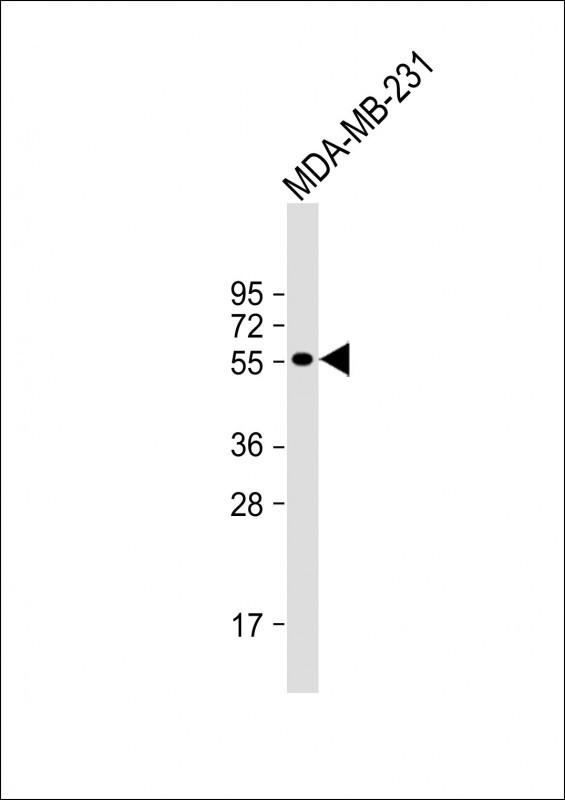
Western Blot at 1:1000 dilution + MDA-MB-231 whole cell lysate Lysates/proteins at 20 ug per lane.| Product Name | DMP1 Antibody |
|---|---|
| Antibody Type | Primary Antibodies |
| Antigen Alias | Dentin matrix acidic phosphoprotein 1, DMP-1, Dentin matrix protein 1, DMP1 |
| Product description | Dentin matrix acidic phosphoprotein is an extracellular matrix protein and a member of the small integrin binding ligand N-linked glycoprotein family. This protein, which is critical for proper mineralization of bone and dentin, is present in diverse cells of bone and tooth tissues. The protein contains a large number of acidic domains, multiple phosphorylation sites, a functional arg-gly-asp cell attachment sequence, and a DNA binding domain. In undifferentiated osteoblasts it is primarily a nuclear protein that regulates the expression of osteoblast-specific genes. During osteoblast maturation the protein becomes phosphorylated and is exported to the extracellular matrix, where it orchestrates mineralized matrix formation. Mutations in the gene are known to cause autosomal recessive hypophosphatemia, a disease that manifests as rickets and osteomalacia. The gene structure is conserved in mammals. Two transcript variants encoding different isoforms have been described for this gene.1) Bailey, S.D., et al. Diabetes Care 33(10):2250-2253(2010) |
| Immunogen | This DMP1 antibody is generated from rabbits immunized with a KLH conjugated synthetic peptide between 146-175 amino acids from the N-terminal region of human DMP1. |
| Clonality | Polyclonal |
|---|---|
| Isotype | Ig |
| Host Species | Rabbit |
| Tested Applications | WB |
| For WB starting dilution is: 1:1000: |
|
| Species Reactivity | Human |
| Concentration | 1mg/ml |
| Purification | Affinity purified |
| Gene Symbol | DMP1 |
|---|---|
| Alternative Names | Dentin matrix acidic phosphoprotein 1 DMP-1 Dentin matrix protein 1 DMP1 |
| Molecular Weight(MW) | 56 kDa |
Application
Western Blot at 1:1000 dilution + MDA-MB-231 whole cell lysate Lysates/proteins at 20 ug per lane.| Application Notes | For WB starting dilution is: 1:1000: |
|---|
| Form | Liquid |
|---|---|
| Storage Instructions | Store at 4˚C for three months and -20˚C, stable for up to one year. As with all antibodies care should be taken to avoid repeated freeze thaw cycles. Antibodies should not be exposed to prolonged high temperatures. |
| Storage Buffer | Supplied in PBS with 0.09% (W/V) sodium azide. |


