Application
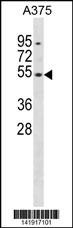
Western blot analysis in A375 cell line lysates (35ug/lane).| Product Name | DUSP10 Antibody |
|---|---|
| Antibody Type | Primary Antibodies |
| Antigen Alias | Dual specificity protein phosphatase 10, Mitogen-activated protein kinase phosphatase 5, MAP kinase phosphatase 5, MKP-5, DUSP10, MKP5 |
| Product description | Dual specificity protein phosphatases inactivate their target kinases by dephosphorylating both the phosphoserine/threonine and phosphotyrosine residues. They negatively regulate members of the MAPK superfamily (MAPK/ERK, SAPK/JNK, p38), which is associated with cellular proliferation and differentiation. Different members of this family of dual specificity phosphatases show distinct substrate specificities for MAPKs, different tissue distribution and subcellular localization, and different modes of inducibility of their expression by extracellular stimuli. This gene product binds to and inactivates p38 and SAPK/JNK, but not MAPK/ERK. Its subcellular localization is unique; it is evenly distributed in both the cytoplasm and the nucleus. This gene is widely expressed in various tissues and organs, and its expression is elevated by stress stimuli. Three transcript variants encoding two different isoforms have been found for this gene.1) Bailey, S.D., et al. Diabetes Care (2010) In press : |
| Immunogen | This DUSP10 antibody is generated from rabbits immunized with a KLH conjugated synthetic peptide between 204-232 amino acids from the Central region of human DUSP10. |
| Clonality | Polyclonal |
|---|---|
| Isotype | Ig |
| Host Species | Rabbit |
| Tested Applications | WB |
| For WB starting dilution is: 1:1000: |
|
| Species Reactivity | Human |
| Concentration | 1mg/ml |
| Purification | Affinity purified |
| Gene Symbol | DUSP10 |
|---|---|
| Alternative Names | Dual specificity protein phosphatase 10 Mitogen-activated protein kinase phosphatase 5 MAP kinase phosphatase 5 MKP-5 DUSP10 MKP5 |
| Molecular Weight(MW) | 53 kDa |
| Sequence Similarities | Predicted species reactivity based on immunogen sequence: Bovine |
Application
Western blot analysis in A375 cell line lysates (35ug/lane).| Application Notes | For WB starting dilution is: 1:1000: |
|---|
| Form | Liquid |
|---|---|
| Storage Instructions | Store at 4˚C for three months and -20˚C, stable for up to one year. As with all antibodies care should be taken to avoid repeated freeze thaw cycles. Antibodies should not be exposed to prolonged high temperatures. |
| Storage Buffer | Supplied in PBS with 0.09% (W/V) sodium azide. |


