Application
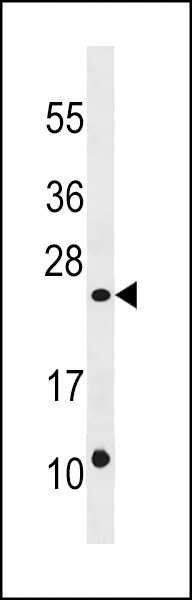
Western blot analysis in A2058 cell line lysates (35ug/lane).| Product Name | DUSP13 Antibody |
|---|---|
| Antibody Type | Primary Antibodies |
| Antigen Alias | Dual specificity protein phosphatase 13 isoform A, DUSP13A, Branching-enzyme interacting DSP, Muscle-restricted DSP, MDSP, DUSP13, BEDP, DUSP13A, MDSP |
| Product description | Members of the protein-tyrosine phosphatase superfamily cooperate with protein kinases to regulate cell proliferation and differentiation. This superfamily is separated into two families based on the substrate that is dephosphorylated. One family, the dual specificity phosphatases (DSPs) acts on both phosphotyrosine and phosphoserine/threonine residues. This gene encodes different but related DSP proteins through the use of non-overlapping open reading frames, alternate splicing, and presumed different transcription promoters. Expression of the distinct proteins from this gene has been found to be tissue specific and the proteins may be involved in postnatal development of specific tissues. A protein encoded by the upstream ORF was found in skeletal muscle, whereas the encoded protein from the downstream ORF was found only in testis. In mouse, a similar pattern of expression was found. Multiple alternatively spliced transcript variants were described, but the full-length sequence of only some were determined.1) Kim, S.J., et al. Proteins 66(1):239-245(2007) |
| Immunogen | This DUSP13 antibody is generated from rabbits immunized with a KLH conjugated synthetic peptide between 147-173 amino acids from the C-terminal region of human DUSP13. |
| Clonality | Polyclonal |
|---|---|
| Isotype | Ig |
| Host Species | Rabbit |
| Tested Applications | WB |
| For WB starting dilution is: 1:1000: |
|
| Species Reactivity | Human |
| Concentration | 1mg/ml |
| Purification | Affinity purified |
| Gene Symbol | DUSP13 |
|---|---|
| Alternative Names | Dual specificity protein phosphatase 13 isoform A DUSP13A Branching-enzyme interacting DSP Muscle-restricted DSP MDSP DUSP13 BEDP DUSP13A MDSP |
| Molecular Weight(MW) | 21 kDa |
Application
Western blot analysis in A2058 cell line lysates (35ug/lane).| Application Notes | For WB starting dilution is: 1:1000: |
|---|
| Form | Liquid |
|---|---|
| Storage Instructions | Store at 4˚C for three months and -20˚C, stable for up to one year. As with all antibodies care should be taken to avoid repeated freeze thaw cycles. Antibodies should not be exposed to prolonged high temperatures. |
| Storage Buffer | Supplied in PBS with 0.09% (W/V) sodium azide. |


