Application
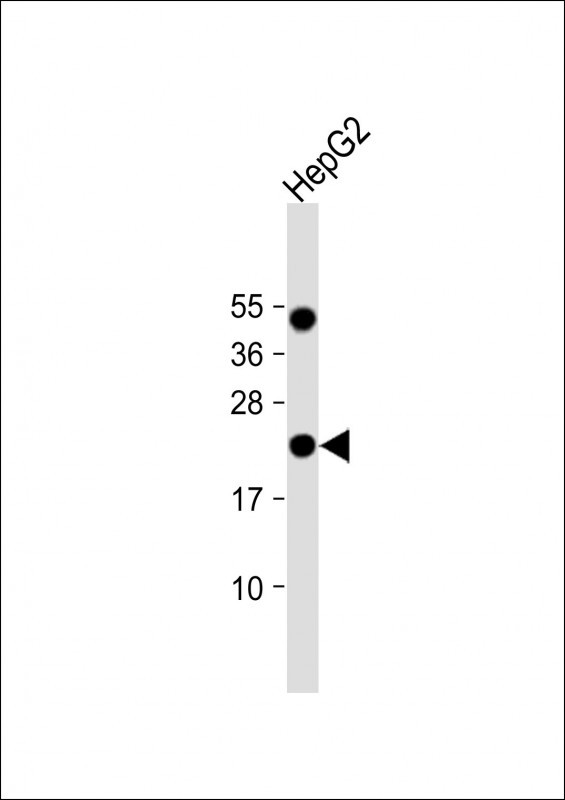
Western Blot at 1:1000 dilution + HepG2 whole cell lysate Lysates/proteins at 20 ug per lane.Application
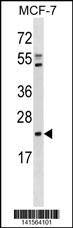
Western blot analysis in MCF-7 cell line lysates (35ug/lane).| Product Name | EBP Antibody |
|---|---|
| Antibody Type | Primary Antibodies |
| Antigen Alias | 3-beta-hydroxysteroid-Delta(8),Delta(7)-isomerase, Cholestenol Delta-isomerase, Delta(8)-Delta(7) sterol isomerase, D8-D7 sterol isomerase, Emopamil-binding protein, EBP |
| Product description | The protein encoded by this gene is an integral membrane protein of the endoplasmic reticulum. It is a high affinity binding protein for the antiischemic phenylalkylamine Ca2+ antagonist [3H]emopamil and the photoaffinity label [3H]azidopamil. It is similar to sigma receptors and may be a member of a superfamily of high affinity drug-binding proteins in the endoplasmic reticulum of different tissues. This protein shares structural features with bacterial and eukaryontic drug transporting proteins. It has four putative transmembrane segments and contains two conserved glutamate residues which may be involved in the transport of cationic amphiphilics. Another prominent feature of this protein is its high content of aromatic amino acid residues (>23%) in its transmembrane segments. These aromatic amino acid residues have been suggested to be involved in the drug transport by the P-glycoprotein. Mutations in this gene cause Chondrodysplasia punctata 2 (CDPX2; also known as Conradi-Hunermann syndrome).1) Lu, Y., et al. J. Lipid Res. 49(12):2582-2589(2008) |
| Immunogen | This EBP antibody is generated from rabbits immunized with a KLH conjugated synthetic peptide between 201-230 amino acids from the C-terminal region of human EBP. |
| Clonality | Polyclonal |
|---|---|
| Isotype | Ig |
| Host Species | Rabbit |
| Tested Applications | WB |
| For WB starting dilution is: 1:1000: |
|
| Species Reactivity | Human |
| Concentration | 1mg/ml |
| Purification | Affinity purified |
| Gene Symbol | EBP |
|---|---|
| Alternative Names | 3-beta-hydroxysteroid-Delta(8) Delta(7)-isomerase Cholestenol Delta-isomerase Delta(8)-Delta(7) sterol isomerase D8-D7 sterol isomerase Emopamil-binding protein EBP |
| Molecular Weight(MW) | 26 kDa |
Application
Western Blot at 1:1000 dilution + HepG2 whole cell lysate Lysates/proteins at 20 ug per lane.
Application
Western blot analysis in MCF-7 cell line lysates (35ug/lane).| Application Notes | For WB starting dilution is: 1:1000: |
|---|
| Form | Liquid |
|---|---|
| Storage Instructions | Store at 4˚C for three months and -20˚C, stable for up to one year. As with all antibodies care should be taken to avoid repeated freeze thaw cycles. Antibodies should not be exposed to prolonged high temperatures. |
| Storage Buffer | Supplied in PBS with 0.09% (W/V) sodium azide. |


