Application
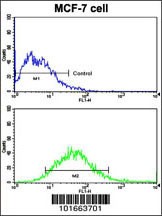
Flow cytometric analysis of MCF-7 cells using EphB6 Antibody (N-term S45) (bottom histogram) compared to a negative control cell (top histogram). FITC-conjugated goat-anti-rabbit secondary antibodies were used for the analysis.Application
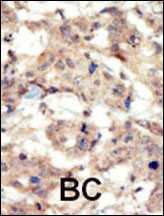
Formalin-fixed and paraffin-embedded human cancer tissue reacted with the primary antibody, which was peroxidase-conjugated to the secondary antibody, followed by DAB staining. BC = breast carcinoma; HC = hepatocarcinoma.Application
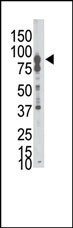
Western blot analysis of anti-EphB6 N-term Pab in A549 cell lysate| Product Name | EphB6 Antibody |
|---|---|
| Antibody Type | Primary Antibodies |
| Antigen Alias | Ephrin type-B receptor 6, HEP, Tyrosine-protein kinase-defective receptor EPH-6, EPHB6 |
| Product description | Ephrin receptors and their ligands, the ephrins, mediate numerous developmental processes, particularly in the nervous system. Based on their structures and sequence relationships, ephrins are divided into the ephrin-A (EFNA) class, which are anchored to the membrane by a glycosylphosphatidylinositol linkage, and the ephrin-B (EFNB) class, which are transmembrane proteins. The Eph family of receptors are divided into 2 groups based on the similarity of their extracellular domain sequences and their affinities for binding ephrin-A and ephrin-B ligands. Ephrin receptors make up the largest subgroup of the receptor tyrosine kinase (RTK) family. EphB6 lacks the kinase activity of most receptor tyrosine kinases and binds to ephrin-B ligands.1) Freywald, A., et al., J. Biol. Chem. 278(12):10150-10156 (2003). |
| Immunogen | This EphB6 antibody is generated from rabbits immunized with a KLH conjugated synthetic peptide between 45-74 amino acids from the N-terminal region of human EphB6. |
| Clonality | Polyclonal |
|---|---|
| Isotype | Ig |
| Host Species | Rabbit |
| Tested Applications | FACSIHC-PWB |
| For WB starting dilution is: 1:1000 For IHC-P starting dilution is: 1:50~100 For FACS starting dilution is: 1:10~50: |
|
| Species Reactivity | Human |
| Concentration | 1mg/ml |
| Gene Symbol | EPHB6 |
|---|---|
| Alternative Names | Ephrin type-B receptor 6 HEP Tyrosine-protein kinase-defective receptor EPH-6 EPHB6 |
| Molecular Weight(MW) | 111 kDa |
| Sequence Similarities | Predicted species reactivity based on immunogen sequence: Mouse |
Application
Flow cytometric analysis of MCF-7 cells using EphB6 Antibody (N-term S45) (bottom histogram) compared to a negative control cell (top histogram). FITC-conjugated goat-anti-rabbit secondary antibodies were used for the analysis.
Application
Formalin-fixed and paraffin-embedded human cancer tissue reacted with the primary antibody, which was peroxidase-conjugated to the secondary antibody, followed by DAB staining. BC = breast carcinoma; HC = hepatocarcinoma.
Application
Western blot analysis of anti-EphB6 N-term Pab in A549 cell lysate| Application Notes | For WB starting dilution is: 1:1000 For IHC-P starting dilution is: 1:50~100 For FACS starting dilution is: 1:10~50: |
|---|
| Form | Liquid |
|---|---|
| Storage Instructions | Store at 4˚C for three months and -20˚C, stable for up to one year. As with all antibodies care should be taken to avoid repeated freeze thaw cycles. Antibodies should not be exposed to prolonged high temperatures. |
| Storage Buffer | Supplied in PBS with 0.09% (W/V) sodium azide. |


