Application
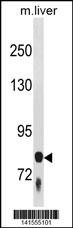
Western blot analysis in mouse liver tissue lysates (35ug/lane).Application
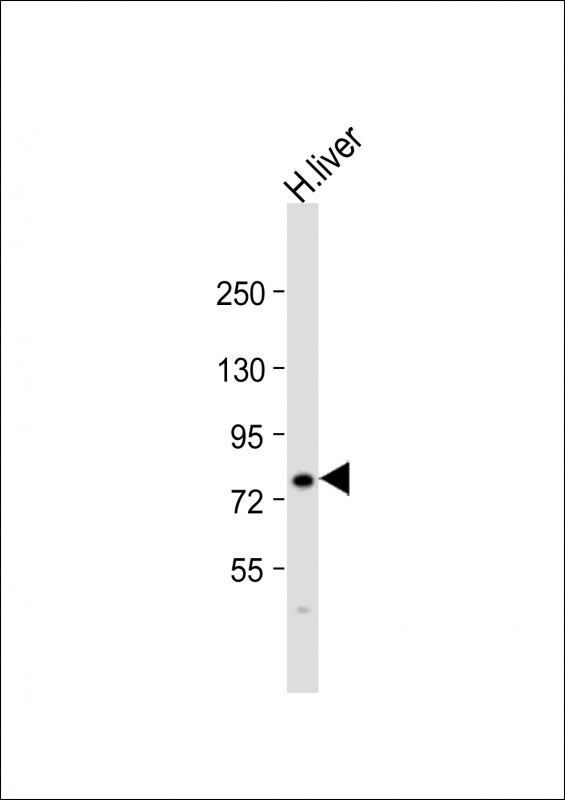
Western Blot at 1:1000 dilution + human liver lysate Lysates/proteins at 20 ug per lane.| Product Name | F13B Antibody |
|---|---|
| Antibody Type | Primary Antibodies |
| Antigen Alias | Coagulation factor XIII B chain, Fibrin-stabilizing factor B subunit, Protein-glutamine gamma-glutamyltransferase B chain, Transglutaminase B chain, F13B |
| Product description | This gene encodes coagulation factor XIII B subunit. Coagulation factor XIII is the last zymogen to become activated in the blood coagulation cascade. Plasma factor XIII is a heterotetramer composed of 2 A subunits and 2 B subunits. The A subunits have catalytic function, and the B subunits do not have enzymatic activity and may serve as a plasma carrier molecules. Platelet factor XIII is comprised only of 2 A subunits, which are identical to those of plasma origin. Upon activation by the cleavage of the activation peptide by thrombin and in the presence of calcium ion, the plasma factor XIII dissociates its B subunits and yields the same active enzyme, factor XIIIa, as platelet factor XIII. This enzyme acts as a transglutaminase to catalyze the formation of gamma-glutamyl-epsilon-lysine crosslinking between fibrin molecules, thus stabilizing the fibrin clot. Factor XIII deficiency is classified into two categories: type I deficiency, characterized by the lack of both the A and B subunits; and type II deficiency, characterized by the lack of the A subunit alone. These defects can result in a lifelong bleeding tendency, defective wound healing, and habitual abortion.1) Silva, L.K., et al. Eur. J. Hum. Genet. 18(11):1221-1227(2010) |
| Immunogen | This F13B antibody is generated from rabbits immunized with a KLH conjugated synthetic peptide between 151-179 amino acids from the N-terminal region of human F13B. |
| Clonality | Polyclonal |
|---|---|
| Isotype | Ig |
| Host Species | Rabbit |
| Tested Applications | WB |
| For WB starting dilution is: 1:1000: |
|
| Species Reactivity | HumanMouse |
| Concentration | 1mg/ml |
| Purification | Affinity purified |
| Gene Symbol | F13B |
|---|---|
| Alternative Names | Coagulation factor XIII B chain Fibrin-stabilizing factor B subunit Protein-glutamine gamma-glutamyltransferase B chain Transglutaminase B chain F13B |
| Molecular Weight(MW) | 76 kDa |
Application
Western blot analysis in mouse liver tissue lysates (35ug/lane).
Application
Western Blot at 1:1000 dilution + human liver lysate Lysates/proteins at 20 ug per lane.| Application Notes | For WB starting dilution is: 1:1000: |
|---|
| Form | Liquid |
|---|---|
| Storage Instructions | Store at 4˚C for three months and -20˚C, stable for up to one year. As with all antibodies care should be taken to avoid repeated freeze thaw cycles. Antibodies should not be exposed to prolonged high temperatures. |
| Storage Buffer | Supplied in PBS with 0.09% (W/V) sodium azide. |


