Application
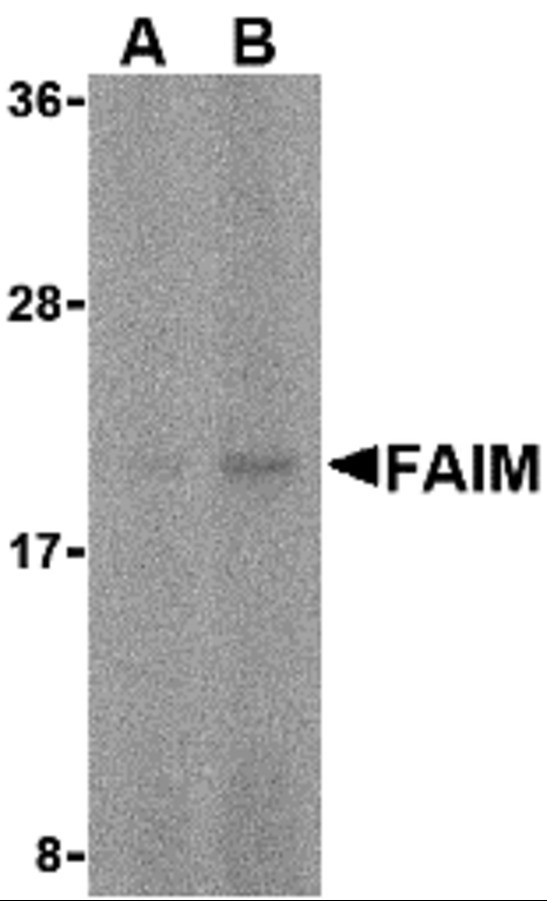
Western blot analysis of FAIM in human spleen tissue lysate with FAIM antibody at (A) 5 and (B) 10 μg/mL.| Product Name | FAIM Antibody |
|---|---|
| Antibody Type | Primary Antibodies |
| Antigen Alias | FAIM Antibody: FAIM1, FAIM1, Fas apoptotic inhibitory molecule 1 |
| Product description | FAIM Antibody: The susceptibility of primary splenic B cells to Fas-mediated apoptosis is regulated in a receptor-specific fashion. Terminal effectors of B cell Fas-resistance include the known anti-apoptotic proteins Bcl-xL, FLIP, and a recently identified protein termed FAIM. This molecule is broadly expressed in various tissues and exists in at least three isoforms. It is thought that resistance to Fas killing via increased expression of FAIM protects foreign antigen-specific B cells during interactions with FasL-bearing T cells whereas autoreactive B cells are deleted via Fas-dependent cytotoxicity. More recent results have indicated that FAIM interacts with both Trk and p75 neurotrophin receptor and may play a role in promoting neurite outgrowth in different neuronal systems by a mechanism involving the activation of NF-κB and the Ras-ERK pathway.1) Rothstein TL. Inducible resistance to Fas-mediated apoptosis in B cells. Cell Res. 2000; 10:245-66. |
| Immunogen | FAIM antibody was raised against a 14 amino acid synthetic peptide from near the carboxy terminus of human FAIM. The immunogen is located within the last 50 amino acids of FAIM. |
| Clonality | Polyclonal |
|---|---|
| Isotype | IgG |
| Host Species | Rabbit |
| Tested Applications | WB |
| FAIM antibody can be used for detection of FAIM by Western blot at 5 - 10 μg/mL.: |
|
| Species Reactivity | Human |
| Concentration | 1mg/ml |
| Purification | Affinity purified |
| Gene Symbol | FAIM |
|---|---|
| Alternative Names | FAIM Antibody: FAIM1 FAIM1 Fas apoptotic inhibitory molecule 1 |
| Sequence Similarities | Predicted species reactivity based on immunogen sequence: Bovine: (100%) |
Application
Western blot analysis of FAIM in human spleen tissue lysate with FAIM antibody at (A) 5 and (B) 10 μg/mL.| Positive Control | 1) Cat. No. 1306 - Human Spleen Tissue Lysate |
|---|---|
| Application Notes | FAIM antibody can be used for detection of FAIM by Western blot at 5 - 10 μg/mL.: |
| Form | Liquid |
|---|---|
| Storage Instructions | FAIM antibody can be stored at 4˚C for three months and -20˚C, stable for up to one year. As with all antibodies care should be taken to avoid repeated freeze thaw cycles. Antibodies should not be exposed to prolonged high temperatures. |
| Storage Buffer | FAIM Antibody is supplied in PBS containing 0.02% sodium azide. |


