Application
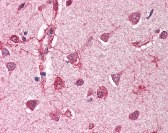
Immunohistochemistry staining of FANCC in brain cortex tissue using FANCC Antibody.| Product Name | FANCC Antibody |
|---|---|
| Antibody Type | Primary Antibodies |
| Product description | FANCC (also called Protein FACC or Fanconi Anemia Group C protein) is involved in DNA repair, perhaps specifically with post-replication repair or a cell cycle checkpoint function. FANCC may also be implicated in interstrand DNA cross-link repair and in the maintenance of normal chromosome stability. FANCC belongs to the multi-subunit Fanconi Anemia (FA) complex composed of FANCA, FANCB, FANCC, FANCE, FANCF, FANCG, FANCL/PHF9 and FANCM. FANCC is mainly found within the nucleus although some protein is localized in the cytoplasm. This protein is ubiquitously expressed. Defects in FANCC are a cause of Fanconi anemia (FA). FA is a genetically heterogeneous, autosomal recessive disorder characterized by progressive pancytopaenia, a diverse assortment of congenital malformations, and a predisposition to the development of malignancies. At the cellular level it is associated with hypersensitivity to DNA-damaging agents, chromosomal instability (increased chromosome breakage), and defective DNA repair. |
| Immunogen | FANCC antibody was raised against amino acids 96-112 near the C-Terminus of FANCC (Human). |
| Clonality | Polyclonal |
|---|---|
| Host Species | Rabbit |
| Tested Applications | ELISAIFIHCWB |
| FANCC antibody can be used in ELISA starting at 0.3 μg/mL, Western Blot, and immunohistochemistry starting at 5 μg/mL. | |
| Species Reactivity | ChimpanzeeHuman |
| Concentration | 1mg/ml |
| Purification | Affinity purified |
| Gene Symbol | FANCC |
|---|---|
| Alternative Names | FANCC FAC Fanconi anemia group C protein FA3 Protein FACC FACC |
Application
Immunohistochemistry staining of FANCC in brain cortex tissue using FANCC Antibody.| Application Notes | FANCC antibody can be used in ELISA starting at 0.3 μg/mL, Western Blot, and immunohistochemistry starting at 5 μg/mL. |
|---|
| Form | Liquid |
|---|---|
| Storage Instructions | Store FANC antibody at 4 ˚C or -20 ˚C. As with all antibodies avoid freeze/thaw cycles. |
| Storage Buffer | 0.02 M potassium phosphate, 0.15 M sodium chloride, pH 7.2, 0.01% sodium azide. |


