Application
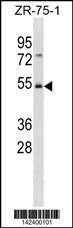
Western blot analysis in ZR-75-1 cell line lysates (35ug/lane).| Product Name | FBXW4 Antibody |
|---|---|
| Antibody Type | Primary Antibodies |
| Product description | This gene is a member of the F-box/WD-40 gene family, which recruit specific target proteins through their WD-40 protein-protein binding domains for ubiquitin mediated degradation. In mouse, a highly similar protein is thought to be responsible for maintaining the apical ectodermal ridge of developing limb buds; disruption of the mouse gene results in the absence of central digits, underdeveloped or absent metacarpal/metatarsal bones and syndactyly. This phenotype is remarkably similar to split hand-split foot malformation in humans, a clinically heterogeneous condition with a variety of modes of transmission. An autosomal recessive form has been mapped to the chromosomal region where this gene is located, and complex rearrangements involving duplications of this gene and others have been associated with the condition. A pseudogene of this locus has been mapped to one of the introns of the BCR gene on chromosome 22.1) Everman, D.B., et al. Am. J. Med. Genet.140(13):1375-1383(2006) |
| Immunogen | This FBXW4 antibody is generated from rabbits immunized with a KLH conjugated synthetic peptide between 341-370 amino acids from the C-terminal region of human FBXW4. |
| Clonality | Polyclonal |
|---|---|
| Isotype | Ig |
| Host Species | Rabbit |
| Tested Applications | WB |
| For WB starting dilution is: 1:1000 | |
| Species Reactivity | Human |
| Concentration | 1mg/ml |
| Purification | Affinity purified |
| Gene Symbol | FBXW4 |
|---|---|
| Alternative Names | F-box/WD repeat-containing protein 4 Dactylin F-box and WD-40 domain-containing protein 4 FBXW4 FBW4 SHFM3 |
| Molecular Weight(MW) | 46 kDa |
Application
Western blot analysis in ZR-75-1 cell line lysates (35ug/lane).| Application Notes | For WB starting dilution is: 1:1000 |
|---|
| Form | Liquid |
|---|---|
| Storage Instructions | Store at 4˚C for three months and -20˚C, stable for up to one year. As with all antibodies care should be taken to avoid repeated freeze thaw cycles. Antibodies should not be exposed to prolonged high temperatures. |
| Storage Buffer | Supplied in PBS with 0.09% (W/V) sodium azide. |


