Application
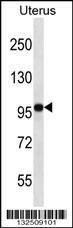
Western blot analysis in human normal Uterus tissue lysates (35ug/lane).| Product Name | FGD4 Antibody |
|---|---|
| Antibody Type | Primary Antibodies |
| Product description | This gene encodes a protein that is involved in the regulation of the actin cytoskeleton and cell shape. This protein contains an actin filament-binding domain, which together with its Dbl homology domain and one of its pleckstrin homology domains, can form microspikes. This protein can activate MAPK8 independently of the actin filament-binding domain, and it is also involved in the activation of CDC42 via the exchange of bound GDP for free GTP. The activation of CDC42 also enables this protein to play a role in mediating the cellular invasion of Cryptosporidium parvum, an intracellular parasite that infects the gastrointestinal tract. Mutations in this gene can cause Charcot-Marie-Tooth disease type 4H (CMT4H), a disorder of the peripheral nervous system. [provided by RefSeq].1) Rose, J. Phd, et al. Mol. Med. (2010) In pressFabrizi, G.M., et al. Neurology 72(13):1160-1164(2009) Houlden, H., et al. Neurology 72(7):617-620(2009) Horlock, C., et al. Int. Arch. Allergy Immunol. 150(3):237-251(2009) Stendel, C., et al. Am. J. Hum. Genet. 81(1):158-164(2007) |
| Immunogen | This FGD4 antibody is generated from rabbits immunized with a KLH conjugated synthetic peptide between 157-186 amino acids from the N-terminal region of human FGD4. |
| Clonality | Polyclonal |
|---|---|
| Isotype | Ig |
| Host Species | Rabbit |
| Tested Applications | WB |
| For WB starting dilution is: 1:1000 | |
| Species Reactivity | Human |
| Concentration | 1mg/ml |
| Purification | Affinity purified |
| Gene Symbol | FGD4 |
|---|---|
| Alternative Names | FYVE RhoGEF and PH domain-containing protein 4 Actin filament-binding protein frabin FGD1-related F-actin-binding protein Zinc finger FYVE domain-containing protein 6 FGD4 FRABP ZFYVE6 |
| Molecular Weight(MW) | 87 kDa |
Application
Western blot analysis in human normal Uterus tissue lysates (35ug/lane).| Application Notes | For WB starting dilution is: 1:1000 |
|---|
| Form | Liquid |
|---|---|
| Storage Instructions | Store at 4˚C for three months and -20˚C, stable for up to one year. As with all antibodies care should be taken to avoid repeated freeze thaw cycles. Antibodies should not be exposed to prolonged high temperatures. |
| Storage Buffer | Supplied in PBS with 0.09% (W/V) sodium azide. |


