Application
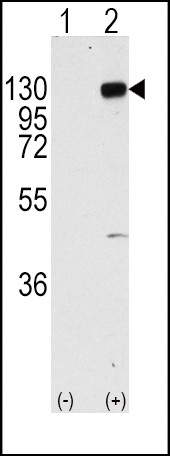
Western blot analysis of FGFR1 using rabbit polyclonal FGFR1 Antibody (Y766) using 293 cell lysates (2 ug/lane) either nontransfected (Lane 1) or transiently transfected with the FGFR1 gene (Lane 2).| Product Name | FGFR1 Antibody |
|---|---|
| Antibody Type | Primary Antibodies |
| Product description | FGFR1 is a member of the fibroblast growth factor receptor family, where amino acid sequence is highly conserved between members and throughout evolution. FGFR family members differ from one another in their ligand affinities and tissue distribution. A full-length representative protein consists of an extracellular region, composed of three immunoglobulin-like domains, a single hydrophobic membrane-spanning segment and a cytoplasmic tyrosine kinase domain. The extracellular portion of the protein interacts with fibroblast growth factors, setting in motion a cascade of downstream signals, ultimately influencing mitogenesis and differentiation. This particular family member binds both acidic and basic fibroblast growth factors and is involved in limb induction. Mutations in this gene can lead to Pfeiffer syndrome and Jackson-Weiss syndrome.1) Jiao, J., et al., Arch. Biochem. Biophys. 410(2):187-200 (2003). |
| Immunogen | This FGFR1 antibody is generated from rabbits immunized with a KLH conjugated synthetic peptide between 744-773 amino acids from human FGFR1. |
| Clonality | Polyclonal |
|---|---|
| Isotype | Ig |
| Host Species | Rabbit |
| Tested Applications | WB |
| For WB starting dilution is: 1:1000 | |
| Species Reactivity | Human |
| Concentration | 1mg/ml |
| Purification | Affinity purified |
| Gene Symbol | FGFR1 |
|---|---|
| Alternative Names | Fibroblast growth factor receptor 1 FGFR-1 Basic fibroblast growth factor receptor 1 BFGFR bFGF-R-1 Fms-like tyrosine kinase 2 FLT-2 N-sam Proto-oncogene c-Fgr CD331 FGFR1 BFGFR CEK FGFBR FLG FLT2 HBGFR |
| Molecular Weight(MW) | 92 kDa |
| Sequence Similarities | Predicted species reactivity based on immunogen sequence: Rat |
Application
Western blot analysis of FGFR1 using rabbit polyclonal FGFR1 Antibody (Y766) using 293 cell lysates (2 ug/lane) either nontransfected (Lane 1) or transiently transfected with the FGFR1 gene (Lane 2).| Application Notes | For WB starting dilution is: 1:1000 |
|---|
| Form | Liquid |
|---|---|
| Storage Instructions | Store at 4˚C for three months and -20˚C, stable for up to one year. As with all antibodies care should be taken to avoid repeated freeze thaw cycles. Antibodies should not be exposed to prolonged high temperatures. |
| Storage Buffer | Supplied in PBS with 0.09% (W/V) sodium azide. |


