Application
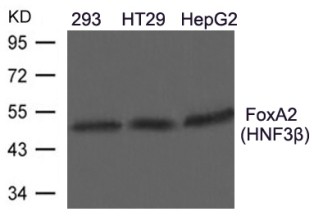
Western blot analysis of lysed extracts from 293, HT29, HepG2 cells using FoxA2 (HNF3β).| Product Name | FoxA2 (HNF3beta) Antibody |
|---|---|
| Antibody Type | Primary Antibodies |
| Antigen Alias | HNF3B, TCF3B, NMDAR1, HNF3B |
| Product description | Transcription factor that is involved in embryonic development, establishment of tissue-specific gene expression and regulation of gene expression in differentiated tissues. Is thought to act as a 'pioneer' factor opening the compacted chromatin for other proteins through interactions with nucleosomal core histones and thereby replacing linker histones at target enhancer and/or promoter sites. Binds DNA with the consensus sequence 5'-[AC]A[AT]T[AG]TT[GT][AG][CT]T[CT]-3' . In embryonic development is required for notochord formation. Involved in the development of multiple endoderm-derived organ systems such as the liver, pancreas and lungs; FOXA1 and FOXA2 seem to have at least in part redundant roles. Originally discribed as a transcription activator for a number of liver genes such as AFP, albumin, tyrosine aminotransferase, PEPCK, etc. Interacts with the cis-acting regulatory regions of these genes. Involved in glucose homeostasis; regulates the expression of genes important for glucose sensing in pancreatic beta-cells and glucose homeostasis. Involved in regulation of fat metabolism. Binds to fibrinogen beta promoter and is involved in IL6-induced fibrinogen beta transcriptional activation.1) Wolfrum C., Besser D., Luca E., Stoffel M. Proc. Natl. Acad. Sci. U. S. A100:11624-11629 (2003) Motallebipour M., Ameur A., Reddy Bysani M. S., Patra K., Wallerman O., Mangion J., Barker M. A., McKerman K. J., Komorowski J., Wadelius C. Genome Biol. 10:R129. 0-R129. 0 (2009) |
| Immunogen | FoxA2 (HNF3beta) antibody was raised against a peptide sequence around aa.435~439 ( A-S-P-L-A) derived from Human FoxA2 (HNF3β). |
| Clonality | Polyclonal |
|---|---|
| Host Species | Rabbit |
| Tested Applications | WB |
| Western Blot: 1:500~1:1000: |
|
| Species Reactivity | Human |
| Concentration | 1mg/ml |
| Purification | Affinity purified |
| Gene Symbol | FOXA2 |
|---|---|
| Alternative Names | HNF3B TCF3B NMDAR1 HNF3B |
| Molecular Weight(MW) | 50 kDa |
| Tissue Specificity | This antibody detects endogenous level of total FoxA2 protein. |
| Entrez Gene | 3170 |
|---|---|
| Protein Accession | NP_068556.2 |
Application
Western blot analysis of lysed extracts from 293, HT29, HepG2 cells using FoxA2 (HNF3β).| Application Notes | Western Blot: 1:500~1:1000: |
|---|
| Form | Liquid |
|---|---|
| Storage Instructions | Store antibody at -20˚C for up to one year. |
| Storage Buffer | Antibody supplied in phosphate buffered saline (without Mg2+ and Ca2+), pH 7.4, 150mM NaCl, 0.02% sodium azide and 50% glycerol. |


