Application
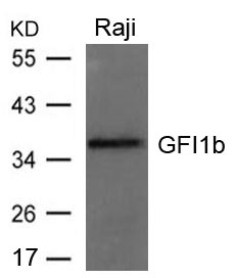
Western blot analysis of lysed extracts from Raji cells using GFI1b Antibody.| Product Name | GFI1b Antibody |
|---|---|
| Antibody Type | Primary Antibodies |
| Product description | Essential proto-oncogenic transcriptional regulator necessary for development and differentiation of erythroid and megakaryocytic lineages. Transcriptional repressor or activator depending on both promoter and cell type context; represses promoter activity of SOCS1 and SOCS3 and thus, may regulate cytokine signaling pathways. Cooperates with GATA1 to repress target gene transcription, such as the apoptosis regulator BCL2L1; GFI1B silencing in leukemic cell lines markedly increase apoptosis rate. Inhibits down-regulation of MYC and MYB as well as the cyclin-dependent kinase inhibitor CDKN1A/P21WAF1 in IL6-treated myelomonocytic cells. Represses expression of GATA3 in T-cell lymphomas and inhibits GATA1-mediated transcription; as GATA1 also mediates erythroid GFI1B transcription, both GATA1 and GFI1B participate in a feedback regulatory pathway controlling the expression of GFI1B gene in erythroid cells. Suppresses GATA1-mediated stimulation of GFI1B promoter through protein interaction. Binds to gamma-satellite DNA and to its own promoter, auto-repressing its own expression. Alters histone methylation by recruiting histone methyltransferase to target genes promoters. Plays a role in heterochromatin formation.1) Osawa M., Yamaguchi T., Nakamura Y., Kaneko S., Onodera M., Sawada K., Jegalian A., Wu H., Nakauchi H., Iwama A. Blood 100:2769-2777 (2002) Huang D. -Y., Kuo Y. -Y., Chang Z. -F. Nucleic Acids Res. 33:5331-5342 (2005) Vassen L., Fiolka K., Moeroey T. EMBO J. 25:2409-2419 (2006) |
| Immunogen | GFI1b antibody was raised against a peptide sequence around aa.322~326 (H-R-E-S-Q) derived from Human GFI1b. |
| Clonality | Polyclonal |
|---|---|
| Host Species | Rabbit |
| Tested Applications | WB |
| Western Blot: 1:500~1:1000 | |
| Species Reactivity | HumanMouseRat |
| Concentration | 1mg/ml |
| Purification | Affinity purified |
| Gene Symbol | GFI1B |
|---|---|
| Alternative Names | BDPLT17 Gfi-1b |
| Molecular Weight(MW) | 38 kDa |
| Tissue Specificity | This antibody detects endogenous level of total GFI1b protein. |
| Entrez Gene | 8328 |
|---|---|
| Protein Accession | NP_001128503.1 |
Application
Western blot analysis of lysed extracts from Raji cells using GFI1b Antibody.| Application Notes | Western Blot: 1:500~1:1000 |
|---|
| Form | Liquid |
|---|---|
| Storage Instructions | Store antibody at -20˚C for up to one year. |
| Storage Buffer | Antibody supplied in phosphate buffered saline (without Mg2+ and Ca2+), pH 7.4, 150mM NaCl, 0.02% sodium azide and 50% glycerol. |


