Application
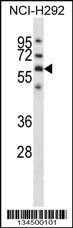
Western blot analysis in NCI-H292 cell line lysates (35ug/lane).| Product Name | GPC3 Antibody |
|---|---|
| Antibody Type | Primary Antibodies |
| Antigen Alias | Glypican-3, GTR2-2, Intestinal protein OCI-5, MXR7, Secreted glypican-3, GPC3, OCI5 |
| Product description | Cell surface heparan sulfate proteoglycans are composed of a membrane-associated protein core substituted with a variable number of heparan sulfate chains. Members of the glypican-related integral membrane proteoglycan family (GRIPS) contain a core protein anchored to the cytoplasmic membrane via a glycosyl phosphatidylinositol linkage. These proteins may play a role in the control of cell division and growth regulation. The protein encoded by this gene can bind to and inhibit the dipeptidyl peptidase activity of CD26, and it can induce apoptosis in certain cell types. Deletion mutations in this gene are associated with Simpson-Golabi-Behmel syndrome, also known as Simpson dysmorphia syndrome. Alternative splicing results in multiple transcript variants.1) Lai, J.P., et al. Hepatology 52(5):1680-1689(2010) |
| Immunogen | This GPC3 antibody is generated from rabbits immunized with a KLH conjugated synthetic peptide between 465-494 amino acids from the C-terminal region of human GPC3. |
| Clonality | Polyclonal |
|---|---|
| Isotype | Ig |
| Host Species | Rabbit |
| Tested Applications | WB |
| For WB starting dilution is: 1:1000: |
|
| Species Reactivity | Human |
| Concentration | 1mg/ml |
| Purification | Affinity purified |
| Gene Symbol | GPC3 |
|---|---|
| Alternative Names | Glypican-3 GTR2-2 Intestinal protein OCI-5 MXR7 Secreted glypican-3 GPC3 OCI5 |
| Molecular Weight(MW) | 66 kDa |
Application
Western blot analysis in NCI-H292 cell line lysates (35ug/lane).| Application Notes | For WB starting dilution is: 1:1000: |
|---|
| Form | Liquid |
|---|---|
| Storage Instructions | Store at 4˚C for three months and -20˚C, stable for up to one year. As with all antibodies care should be taken to avoid repeated freeze thaw cycles. Antibodies should not be exposed to prolonged high temperatures. |
| Storage Buffer | Supplied in PBS with 0.09% (W/V) sodium azide. |


