Application
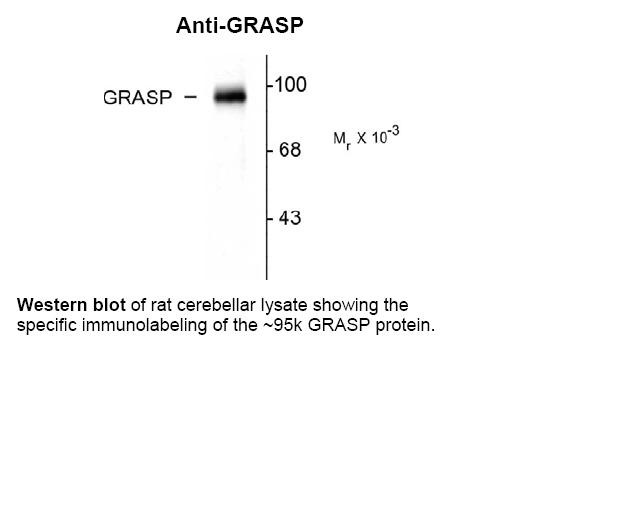
Western blot of rat cerebellar lysate showing the specific immunolabeling of the ~95k GRASP protein.| Product Name | GRASP Antibody |
|---|---|
| Antibody Type | Primary Antibodies |
| Product description | PDZ domain-containing proteins, such as PSD-95 and GRIP are thought to play key roles in glutamate receptor plasticity. GRIP-associated proteins (GRASPs) that bind to distinct PDZ domains within GRIP also play key roles in regulation of glutamate receptor function. GRASP-1 is a neuronal rasGEF associated with GRIP and AMPA receptors in vivo (Scannevin and Huganir, 2000). Recent work suggests that GRASP-1 may regulate neuronal ras signaling and contribute to the regulation of AMPA receptor distribution by NMDA receptor activity (Ye et al., 2000).1) Scannevin RH, Huganir RL (2000) Postsynaptic organization and regulation of excitatory synapses. Nat Rev Neurosci 1:133-141. |
| Immunogen | Peptide corresponding to amino acid residues from the C-terminal region of rat GRASP, conjugated to keyhole limpet hemocyanin (KLH). |
| Clonality | Polyclonal |
|---|---|
| Host Species | Rabbit |
| Tested Applications | WB |
| The antibody has been directly tested for reactivity in Western blots with rat tissue. It is anticipated that the antibody will react with bovine, canine, human and mouse based on the fact that these species have 100% homology with the amino acid sequence used as antigen. | |
| Species Reactivity | BovineDogHumanMouseRat |
| Concentration | 1mg/ml |
| Purification | Affinity purified |
| Gene Symbol | Gripap1 |
|---|---|
| Alternative Names | Grasp1 Grasp1 GRASP-1 |
| Molecular Weight(MW) | 95 |
Application
Western blot of rat cerebellar lysate showing the specific immunolabeling of the ~95k GRASP protein.| Application Notes | The antibody has been directly tested for reactivity in Western blots with rat tissue. It is anticipated that the antibody will react with bovine, canine, human and mouse based on the fact that these species have 100% homology with the amino acid sequence used as antigen. |
|---|
| Form | Liquid |
|---|---|
| Storage Instructions | GRASP antibody can be stored at -20˚C and is stable at -20˚C for at least 1 year. |
| Storage Buffer | 100 uL in 10 mM HEPES (pH 7.5), 150 mM NaCl, 100 ug per mL BSA and 50% glycerol. |


