Application
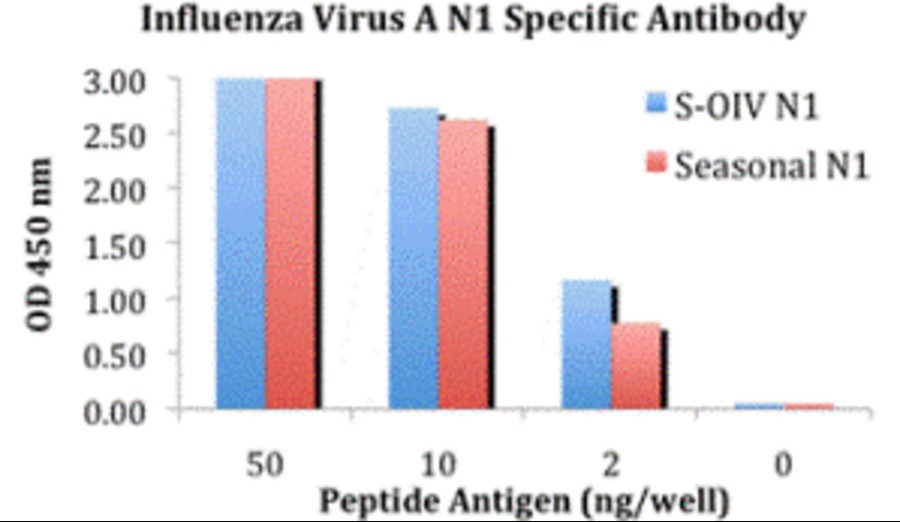
ELISA results using H1N1 Neuraminidase antibody at 1 μg/mL and the blocking and corresponding peptides at 50, 10, 2 and 0 ng/mL.| Product Name | H1N1 Neuraminidase Antibody |
|---|---|
| Antibody Type | Primary Antibodies |
| Antigen Alias | H1N1 Neuraminidase Antibody: |
| Product description | H1N1 Neuraminidase Antibody: Influenza A virus is a major public health threat, killing more than 30, 000 people per year in the USA. In early 2009, a novel swine-origin influenza A (H1N1) virus was identified in specimens obtained from patients in Mexico and the United States. The virus spread quickly around the world and on June 11, 2009, the World Health Organization declared it a pandemic. Influenza A virus has one of sixteen possible Hemagglutinin (HA) surface proteins and one of nine possible Neuraminidase (NA) surface proteins. The Hemagglutinin protein facilitates viral attachment while Neuraminidase is involved in viral release. These proteins also elicit immune responses that prevent infection or independently reduce viral replication. The genetic make-up of this swine flu virus is unlike any other: it is an H1N1 strain that combines a triple assortment first identified in 1998 including human, swine, and avian influenza with two new pig H3N2 virus genes from Eurasia, themselves of recent human origin. The distinct antigenic properties of the new swine influenza virus compared with seasonal influenza A (H1N1) virus suggest that human immunity against new swine influenza virus is limited, although the age distribution of reported cases suggests some degree of protection in older age groups.1) Thompson WW, Shay DK, Weintraub, et al. Mortality associated with influenza and respiratory syncytial virus in the United States. JAMA2003; 289:179-186. |
| Immunogen | Neuraminidase antibody was raised against synthetic peptides from the seasonal influenza (H1N1) Neuraminidase protein and the novel swine influenza Neuraminidase protein. The antibody recognizes both variants. The immunogen is located within the first 50 |
| Clonality | Polyclonal |
|---|---|
| Isotype | IgG |
| Host Species | Rabbit |
| Tested Applications | ELISA |
| Neuraminidase antibody can be used for the detection of the Neuraminidase protein from the seasonal influenza A (H1N1) and the novel swine influenza in ELISA. It will detect 2 ng of free peptide at 1 μg/mL.: |
|
| Species Reactivity | Virus |
| Concentration | 1mg/ml |
| Purification | Affinity purified |
| Gene Symbol | NA |
|---|---|
| Alternative Names | H1N1 Neuraminidase Antibody: |
| Tissue Specificity | This antibody will recognize the Neuraminidase from the both the seasonal influenza (H1N1) and swine-origin influenza virus (A/California/14/2009 (H1N1)). |
| Protein Accession | ACA33620/ACQ76308 |
|---|
Application
ELISA results using H1N1 Neuraminidase antibody at 1 μg/mL and the blocking and corresponding peptides at 50, 10, 2 and 0 ng/mL.| Application Notes | Neuraminidase antibody can be used for the detection of the Neuraminidase protein from the seasonal influenza A (H1N1) and the novel swine influenza in ELISA. It will detect 2 ng of free peptide at 1 μg/mL.: |
|---|
| Form | Liquid |
|---|---|
| Storage Instructions | H1N1 Neuraminidase antibody can be stored at 4˚C for three months and -20˚C, stable for up to one year. As with all antibodies care should be taken to avoid repeated freeze thaw cycles. Antibodies should not be exposed to prolonged high temperatures. |
| Storage Buffer | H1N1 Neuraminidase Antibody is supplied in PBS containing 0.02% sodium azide. |


