Application
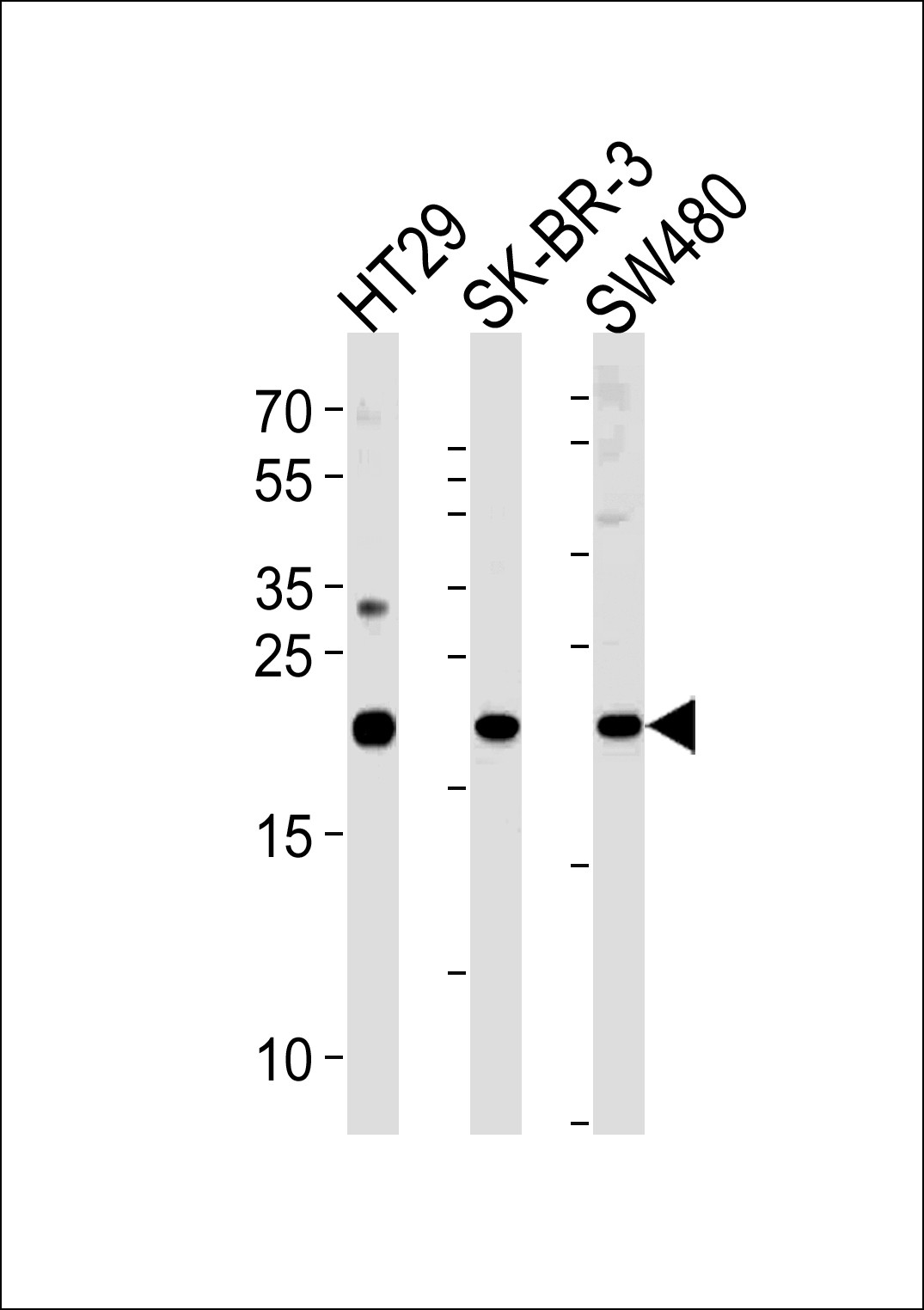
Western blot analysis in HT29,SK-BR-3,SW480 cell line lysates (35ug/lane).| Product Name | HAND1 Antibody |
|---|---|
| Antibody Type | Primary Antibodies |
| Product description | The protein encoded by this gene belongs to the basic helix-loop-helix family of transcription factors. This gene product is one of two closely related family members, the HAND proteins, which are asymmetrically expressed in the developing ventricular chambers and play an essential role in cardiac morphogenesis. Working in a complementary fashion, they function in the formation of the right ventricle and aortic arch arteries, implicating them as mediators of congenital heart disease. In addition, it has been suggested that this transcription factor may be required for early trophoblast differentiation.1) Reamon-Buettner, S.M., et al. Hum. Mol. Genet. 18(19):3567-3578(2009) Martinez Hoyos, J., et al. Oncogene 28(6):876-885(2009) Reamon-Buettner, S.M., et al. Hum. Mol. Genet. 17(10):1397-1405(2008) Morin, S., et al. J. Biol. Chem. 280(37):32272-32278(2005) Hill, A.A., et al. Mol. Cell. Biol. 24(22):9835-9847(2004) |
| Immunogen | This HAND1 antibody is generated from rabbits immunized with a KLH conjugated synthetic peptide between 76-105 amino acids from the Central region of human HAND1. |
| Clonality | Polyclonal |
|---|---|
| Isotype | Ig |
| Host Species | Rabbit |
| Tested Applications | WB |
| For WB starting dilution is: 1:1000 | |
| Species Reactivity | Human |
| Concentration | 1mg/ml |
| Purification | Affinity purified |
| Gene Symbol | HAND1 |
|---|---|
| Alternative Names | Heart- and neural crest derivatives-expressed protein 1 Class A basic helix-loop-helix protein 27 bHLHa27 Extraembryonic tissues heart autonomic nervous system and neural crest derivatives-expressed protein 1 eHAND HAND1 BHLHA27 EHAND |
| Molecular Weight(MW) | 24 kDa |
| Sequence Similarities | Predicted species reactivity based on immunogen sequence: Bovine |
Application
Western blot analysis in HT29,SK-BR-3,SW480 cell line lysates (35ug/lane).| Application Notes | For WB starting dilution is: 1:1000 |
|---|
| Form | Liquid |
|---|---|
| Storage Instructions | Store at 4˚C for three months and -20˚C, stable for up to one year. As with all antibodies care should be taken to avoid repeated freeze thaw cycles. Antibodies should not be exposed to prolonged high temperatures. |
| Storage Buffer | Supplied in PBS with 0.09% (W/V) sodium azide. |


