Application
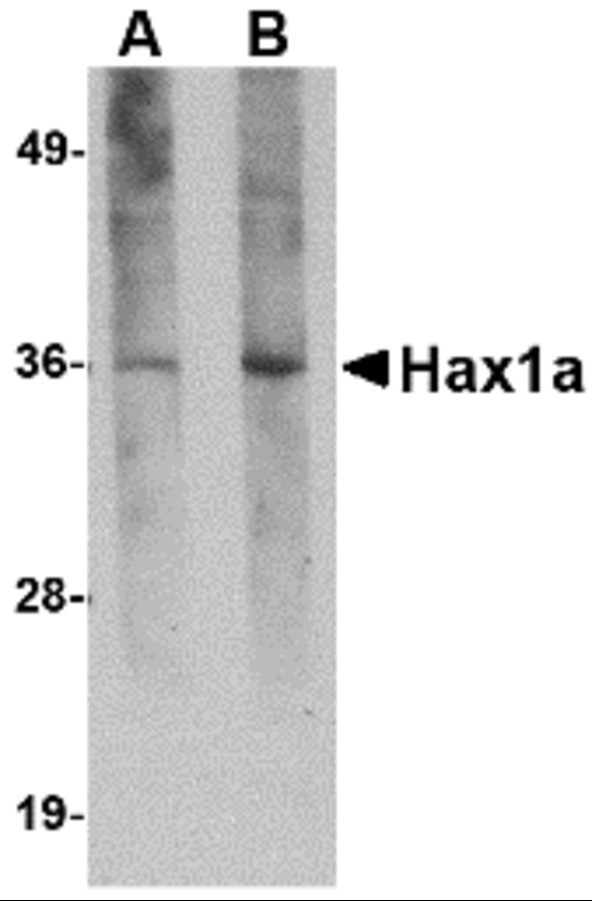
Western blot analysis of Hax1a in human brain tissue lysate with Hax1a antibody at (A) 1 and (B) 2 μg/mL.| Product Name | Hax1a Antibody |
|---|---|
| Antibody Type | Primary Antibodies |
| Antigen Alias | Hax1a Antibody [8F9G7] : SCN3, HS1BP1, HCLSBP1 |
| Product description | Hax1a Monoclonal Antibody: The HS-1 associated protein X-1 (Hax1) was initially identified in a yeast two-hybrid assay on the basis of its ability to bind to the hemapoietic cell-specific protein 1 (HS-1). Hax1 possesses anti-apoptotic activity and is structurally related to Bcl-2 family members, including the presence of BH1- and BH2-like domains. It has recently been shown to interact with HIV viral protein R (Vpr), a protein required for viral pathogenesis of HIV and linked to T-cell apoptosis through activation of caspases 3 and 9. Other studies indicate that Hax1-mediated processing of HtrA2 (also known as Omi) by the mitochondrial protease PARL allows survival of lymphocytes and neurons when cytokines are limiting. At least four isoforms of Hax1 are known to exist. This antibody is expected to recognize the longest isoform (Hax1a) as well as the shortest.1) Suzuki Y, Demoliere C, Kitamura D, et al. HAX-1, a novel intracellular protein, localized on mitochondria directly associates with HS1, a substrate of Src family tyrosine kinases. J. Immunol. 1997; 158:2736-44. |
| Immunogen | Mouse monoclonal Hax1a antibody was raised against a 15 amino acid synthetic peptide near the amino terminus of human Hax1a. |
| Clonality | Monoclonal |
|---|---|
| Host Species | Mouse |
| Tested Applications | ELISAWB |
| Hax1a antibody can be used for detection of Hax1A by Western blot at 1 - 2 μg/mL.: |
|
| Species Reactivity | HumanMouseRat |
| Concentration | 1mg/ml |
| Purification | Affinity purified |
| Gene Symbol | HAX1 |
|---|---|
| Alternative Names | Hax1a Antibody [8F9G7] : SCN3 HS1BP1 HCLSBP1 |
Application
Western blot analysis of Hax1a in human brain tissue lysate with Hax1a antibody at (A) 1 and (B) 2 μg/mL.| Application Notes | Hax1a antibody can be used for detection of Hax1A by Western blot at 1 - 2 μg/mL.: |
|---|
| Form | Liquid |
|---|---|
| Storage Instructions | Hax1a monoclonal antibody can be stored at -20˚C, stable for one year. |
| Storage Buffer | Hax1a Monoclonal Antibody is supplied in PBS containing 0.02% sodium azide. |


