Application
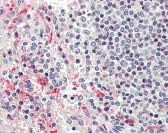
Immunohistochemistry staining of Heparanase in spleen tissue using Heparanase Antibody.| Product Name | Heparanase Antibody |
|---|---|
| Antibody Type | Primary Antibodies |
| Product description | Heparanase is an endo-beta-D-glucuronidase, which degrades heparan sulfate side chains of heparan sulfate proteoglycans (HSPGs) in the extracellular matrix. Heparanase plays an important role in ECM degradation, facilitating the migration and extravasation of tumor cells and inflammatory leukocytes. Upon degradation, heparanase releases growth factors and cytokines that stimulate cell proliferation and chemotaxis. Heparanase is a heterodimer comprised of a 50k D subunit harboring the active site and a 8kD subunit. It is produced as a latent 65 kD precursor and proteolytically processed to its active form. Heparanase is highly expressed in myeloid leukocytes (i.e. neutrophils) in platelets and in human placenta. Human heparanase was found to be upregulated in various types of primary tumors, correlating in some cases with increased tumor invasiveness and vascularity and with poor prospective survival. Suitable for use in Western Blot and Immunohistochemistry. Other applications have not been tested. Reacts with the 65 kD precursor as well as the 50 kD and 8 kD subunits of human or mouse Heparanase. |
| Immunogen | Heparanase antibody was raised against 50kD - 8kD Heparanase heterodimer (Human). |
| Clonality | Polyclonal |
|---|---|
| Isotype | IgG |
| Host Species | Rabbit |
| Tested Applications | IHCWB |
| Heparanase antibody can be used in ELISA, Western Blot starting at 1:500 - 1:1000, immunohistochemistry starting at 5 μg/mL, and immunofluorescence starting at 10 μg/mL. | |
| Species Reactivity | HumanMouse |
| Concentration | 1mg/ml |
| Purification | Protein G |
| Gene Symbol | HPSE |
|---|---|
| Alternative Names | HPSE Endo-glucoronidase Heparanase-1 Heparanase HPA HSE1 HEP HPA1 HPSE1 HPR1 |
| Tissue Specificity | Recognizes the 65kD precursor as well as the 50kD and 8kD subunits of human or mouse Heparanase. |
Application
Immunohistochemistry staining of Heparanase in spleen tissue using Heparanase Antibody.| Application Notes | Heparanase antibody can be used in ELISA, Western Blot starting at 1:500 - 1:1000, immunohistochemistry starting at 5 μg/mL, and immunofluorescence starting at 10 μg/mL. |
|---|
| Form | Liquid |
|---|---|
| Storage Instructions | Store Heparanase antibody at 4 ˚C or -20 ˚C. As with all antibodies avoid freeze/thaw cycles. |
| Storage Buffer | PBS, pH 7.2, 0.01% Thimerosal |


