Application
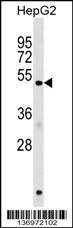
Western blot analysis in HepG2 cell line lysates (35ug/lane).| Product Name | HERPUD1 Antibody |
|---|---|
| Antibody Type | Primary Antibodies |
| Product description | The accumulation of unfolded proteins in the endoplasmic reticulum (ER) triggers the ER stress response. This response includes the inhibition of translation to prevent further accumulation of unfolded proteins, the increased expression of proteins involved in polypeptide folding, known as the unfolded protein response (UPR), and the destruction of misfolded proteins by the ER-associated protein degradation (ERAD) system. This gene may play a role in both UPR and ERAD. Its expression is induced by UPR and it has an ER stress response element in its promoter region while the encoded protein has an N-terminal ubiquitin-like domain which may interact with the ERAD system. This protein has been shown to interact with presenilin proteins and to increase the level of amyloid-beta protein following its overexpression. Alternative splicing of this gene produces multiple transcript variants, some encoding different isoforms. The full-length nature of all transcript variants has not been determined. [provided by RefSeq].1) Hirabayashi, Y., et al. J. Immunol. 184(6):3276-3283(2010) |
| Immunogen | This HERPUD1 antibody is generated from rabbits immunized with a KLH conjugated synthetic peptide between 55-83 amino acids from the N-terminal region of human HERPUD1. |
| Clonality | Polyclonal |
|---|---|
| Isotype | Ig |
| Host Species | Rabbit |
| Tested Applications | WB |
| For WB starting dilution is: 1:1000 | |
| Species Reactivity | Human |
| Concentration | 1mg/ml |
| Purification | Affinity purified |
| Gene Symbol | HERPUD1 |
|---|---|
| Alternative Names | Homocysteine-responsive endoplasmic reticulum-resident ubiquitin-like domain member 1 protein Methyl methanesulfonate (MMF)-inducible fragment protein 1 HERPUD1 HERP KIAA0025 MIF1 |
| Molecular Weight(MW) | 44 kDa |
Application
Western blot analysis in HepG2 cell line lysates (35ug/lane).| Application Notes | For WB starting dilution is: 1:1000 |
|---|
| Form | Liquid |
|---|---|
| Storage Instructions | Store at 4˚C for three months and -20˚C, stable for up to one year. As with all antibodies care should be taken to avoid repeated freeze thaw cycles. Antibodies should not be exposed to prolonged high temperatures. |
| Storage Buffer | Supplied in PBS with 0.09% (W/V) sodium azide. |


