Application
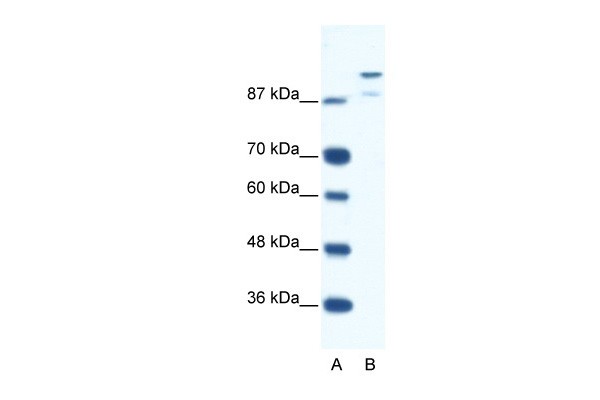
Antibody used in WB on Human Jurkat 0.3125 ug/ml.| Product Name | HKR1 Antibody |
|---|---|
| Antibody Type | Primary Antibodies |
| Antigen Alias | HKR1, ZNF875 |
| Product description | HKR1 is one of the GLI-Kruppel family of human genes. Members of this family have similar H-C links, i.e., a conserved stretch of 9 amino acids connecting the C-terminal histidine of one finger to the N-terminal cysteine of the next. On the basis of amino acid sequence and intron-exon organization, the genes could be placed into one of two subgroups: the GLI subgroup (with the consensus finger amino acid sequence [Y/F]XCX3GCX3[F/Y]X5LX2HX3-4H[T/S]GEKP) or the Kr subgroup (with the consensus finger amino acid sequence [Y/F]XCX2CX3FX5LX2HXRXHTGEKP).1) Suzuki, Y., et al., Gene 200 (1-2), 149-156 (1997). |
| Immunogen | Antibody produced in rabbits immunized with a synthetic peptide corresponding a region of human HKR1. |
| Clonality | Polyclonal |
|---|---|
| Host Species | Rabbit |
| Tested Applications | ELISAWB |
| HKR1 antibody can be used for detection of HKR1 by ELISA at 1:62500. HKR1 antibody can be used for detection of HKR1 by western blot at 0.3125 μg/mL, and HRP conjugated secondary antibody should be diluted 1:50,000 - 100,000.: |
|
| Species Reactivity | Human |
| Concentration | 1mg/ml |
| Purification | Protein A |
| Gene Symbol | HKR1 |
|---|---|
| Alternative Names | HKR1 ZNF875 |
| Molecular Weight(MW) | 75 kDa |
Application
Antibody used in WB on Human Jurkat 0.3125 ug/ml.| Positive Control | 1) Cat. No. 1205 - Jurkat Cell Lysate |
|---|---|
| Application Notes | HKR1 antibody can be used for detection of HKR1 by ELISA at 1:62500. HKR1 antibody can be used for detection of HKR1 by western blot at 0.3125 μg/mL, and HRP conjugated secondary antibody should be diluted 1:50,000 - 100,000.: |
| Form | Liquid |
|---|---|
| Storage Instructions | For short periods of storage (days) store at 4˚C. For longer periods of storage, store HKR1 antibody at -20˚C. As with any antibody avoid repeat freeze-thaw cycles. |
| Storage Buffer | IgG in phosphate buffered saline , pH 7.4, 150mM NaCl, 0.02% sodium azide and 50% glycerol.Store at -20 °C.Stable for 12 months from date of receipt |


