Application
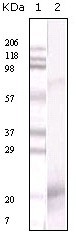
Western blot analysis using IFN - gamma monoclonal antibody against truncated IFN - gamma recombinant protein.| Product Name | IFNgamma Antibody |
|---|---|
| Antibody Type | Primary Antibodies |
| Antigen Alias | Immune interferon, IFN-gamma, IFG, IFI |
| Product description | Interferon-g (IFN-γ) is a pro-inflammatory cytokine that is central in host resistance to infection. It is mainly produced by natural killer cells and CD4+ and CD8+ T cells, its receptors are found on nearly all cells, where it activates diverse responses that enable potential host cells to prevent invasive infection by bacteria, parasites and viruses. Takayanagi et al. (2000) demonstrated that IFN-γ strongly suppresses osteoclastogenesis by interfering with the RANKL (602642)-RANK (603499) signaling pathway. Tsubota et al. (1999) reported that this upregulation in Sjogren syndrome patients may be controlled by interferon-gamma through the activation of transcription factor NFKB.1) Takayanagi, H. et al. Nature 2000. 408: 600-605. |
| Immunogen | Ni-NTA purified recombinant human IFN-γ expressed in E. Coli strain BL21 (DE3). |
| Clonality | Monoclonal |
|---|---|
| Isotype | IgG1 |
| Host Species | Mouse |
| Tested Applications | ELISAWB |
| Western Blot:1:500 - 1,000 ELISA:Determining optimal working dilutions by titration test.: |
|
| Species Reactivity | Human |
| Concentration | 1mg/ml |
| Purification | Affinity purified |
| Gene Symbol | IFNG |
|---|---|
| Alternative Names | Immune interferon IFN-gamma IFG IFI |
Application
Western blot analysis using IFN - gamma monoclonal antibody against truncated IFN - gamma recombinant protein.| Application Notes | Western Blot:1:500 - 1,000 ELISA:Determining optimal working dilutions by titration test.: |
|---|
| Form | Liquid |
|---|---|
| Storage Instructions | IFN-gamma monoclonal antibody can be stored at -20˚C, stable for one year. As with all antibodies care should be taken to avoid repeated freeze thaw cycles. Antibodies should not be exposed to prolonged high temperatures. |
| Storage Buffer | Purified antibody in PBS containing 0.03% sodium azide |


