Application
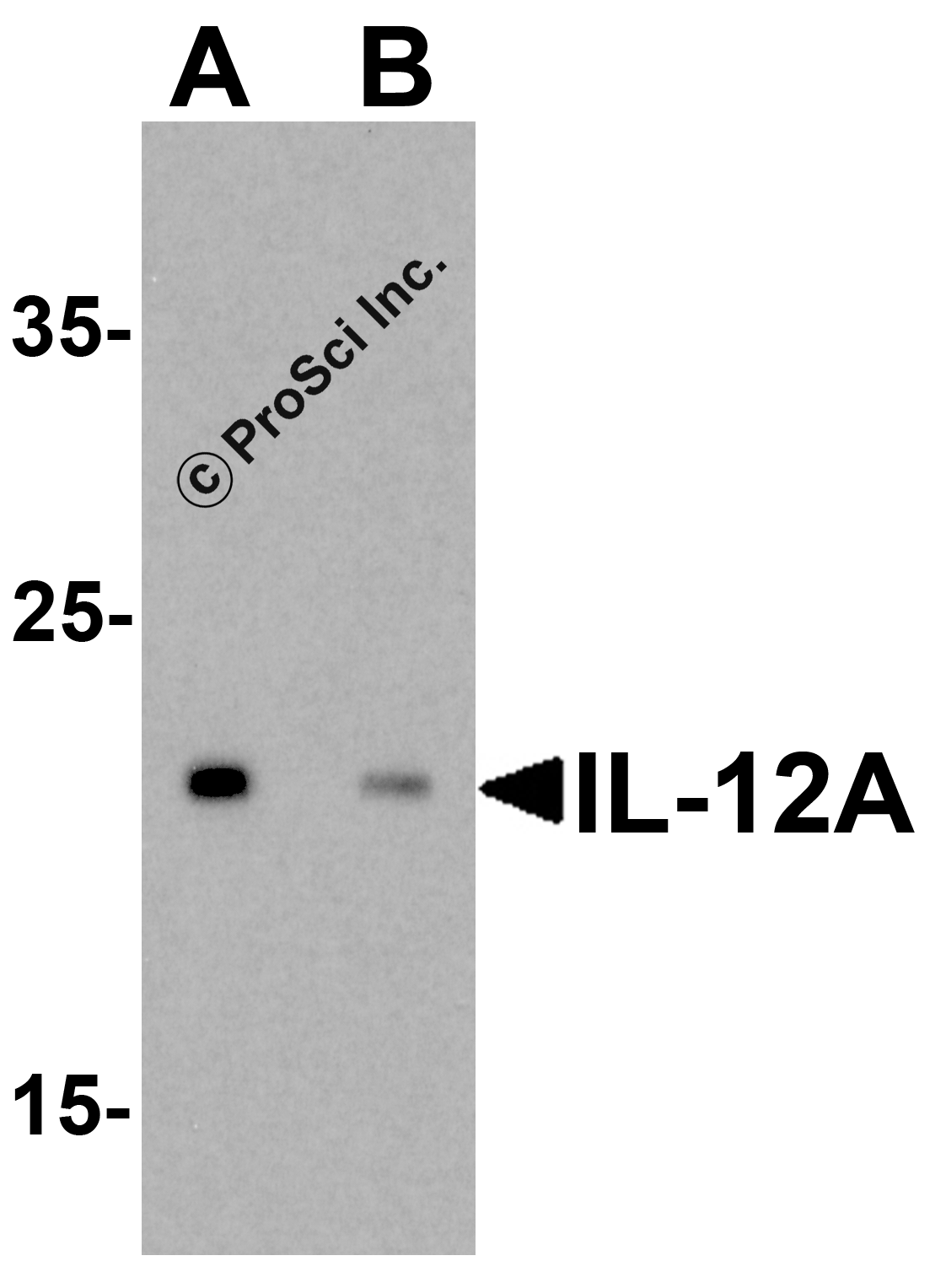
Western blot analysis of IL-12A in HeLa cell lysate with IL-12A antibody at 0.5 μg/ml in (A) the absence and (B) the presence of blocking peptide.| Product Name | IL-12A Antibody |
|---|---|
| Antibody Type | Primary Antibodies |
| Antigen Alias | Interleukin 12 alpha, p35, natural killer cell stimulatory factor 1, NKSF1, cytotoxic lymphocyte maturation factor 1, CLMF, NF cell stimulatory factor chain 1, NFSK |
| Product description | IL-12A is subunit of the cytokine IL-12 which acts on T- and natural killer cells, and has a broad array of biological activities. IL-12 is a disulfide-linked heterodimer composed of the 35-kD subunit and a 40-kD subunit that is a member of the cytokine receptor family (1). IL-12 is required for the T-cell-independent induction of interferon (IFN)-gamma, and is important for the differentiation of both Th1 and Th2 cells (1,2). The responses of lymphocytes to IL-12 are mediated by the activator of transcription protein STAT4 (2). Nitric oxide synthase 2A (NOS2A/NOS2) is found to be required for the signaling process of this cytokine in innate immunity (3).1) Gee K, Guzzo C, Che Mat NF, et al. The IL-12 family of cytokines in infection, inflammation and autoimmune disorders. Inflamm. Allergy Drug Targets 2009; 8:40-52. |
| Immunogen | IL-12A antibody was raised against an 18 amino acid peptide near the carboxy terminus of human IL-12A. The immunogen is located within the last 50 amino acids of IL-12A. |
| Clonality | Polyclonal |
|---|---|
| Isotype | IgG |
| Host Species | Rabbit |
| Tested Applications | ELISAWB |
| IL-12A antibody can be used for detection of IL-12A by Western blot at 0.5 - 1 μg/ml.: |
|
| Species Reactivity | Human |
| Concentration | 1mg/ml |
| Purification | Affinity purified |
| Gene Symbol | IL 12A |
|---|---|
| Alternative Names | Interleukin 12 alpha p35 natural killer cell stimulatory factor 1 NKSF1 cytotoxic lymphocyte maturation factor 1 CLMF NF cell stimulatory factor chain 1 NFSK |
| Molecular Weight(MW) | Predicted: 22 kDa Observed: 22 kDa |
| Sequence Similarities | Predicted species reactivity based on immunogen sequence: Llama: (94%) |
| Tissue Specificity | IL-12A antibody is human specific. IL-12A antibody will not cross-react with IL-12B. |
Application
Western blot analysis of IL-12A in HeLa cell lysate with IL-12A antibody at 0.5 μg/ml in (A) the absence and (B) the presence of blocking peptide.| Positive Control | 1) Cat. No. 1201 - HeLa Cell Lysate |
|---|---|
| Application Notes | IL-12A antibody can be used for detection of IL-12A by Western blot at 0.5 - 1 μg/ml.: |
| Form | Liquid |
|---|---|
| Storage Instructions | IL-12A antibody can be stored at 4˚C for three months and -20˚C, stable for up to one year. |
| Storage Buffer | IL-12A antibody is supplied in PBS containing 0.02% sodium azide. |


