Application
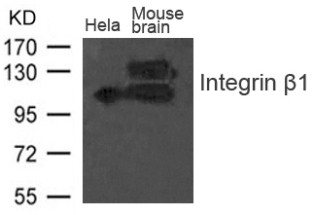
Western blot analysis of extract from Mouse brain tissue and HeLa cells using Integrin β1 (CD29).| Product Name | Integrin beta1 (CD29) Antibody |
|---|---|
| Antibody Type | Primary Antibodies |
| Antigen Alias | CD29, FNRB, MDF2, VLAB, GPIIA, MSK12, VLA-BETA, ITGB1 |
| Product description | Integrins alpha-1/beta-1, alpha-2/beta-1, alpha-10/beta-1 and alpha-11/beta-1 are receptors for collagen. Integrins alpha-1/beta-1 and alpha-2/beta-2 recognize the proline-hydroxylated sequence G-F-P-G-E-R in collagen. Integrins alpha-2/beta-1, alpha-3/beta-1, alpha-4/beta-1, alpha-5/beta-1, alpha-8/beta-1, alpha-10/beta-1, alpha-11/beta-1 and alpha-V/beta-1 are receptors for fibronectin. Alpha-4/beta-1 recognizes one or more domains within the alternatively spliced CS-1 and CS-5 regions of fibronectin. Integrin alpha-5/beta-1 is a receptor for fibrinogen. Integrin alpha-1/beta-1, alpha-2/beta-1, alpha-6/beta-1 and alpha-7/beta-1 are receptors for lamimin. Integrin alpha-4/beta-1 is a receptor for VCAM1. It recognizes the sequence Q-I-D-S in VCAM1. Integrin alpha-9/beta-1 is a receptor for VCAM1, cytotactin and osteopontin. It recognizes the sequence A-E-I-D-G-I-E-L in cytotactin. Integrin alpha-3/beta-1 is a receptor for epiligrin, thrombospondin and CSPG4. Alpha-3/beta-1 may mediate with LGALS3 the stimulation by CSPG4 of endothelial cells migration. Integrin alpha-V/beta-1 is a receptor for vitronectin. Beta-1 integrins recognize the sequence R-G-D in a wide array of ligands. Isoform beta-1B interferes with isoform beta-1A resulting in a dominant negative effect on cell adhesion and migration (in vitro). In case of HIV-1 infection, the interaction with extracellular viral Tat protein seems to enhance angiogenesis in Kaposi's sarcoma lesions. When associated with alpha-7/beta-1 integrin, regulates cell adhesion and laminin matrix deposition. Involved in promoting endothelial cell motility and angiogenesis. May be involved in up-regulation of the activity of kinases such as PKC via binding to KRT1. Together with KRT1 and GNB2L1/RACK1, serves as a platform for SRC activation or inactivation. Plays a mechanistic adhesive role during telophase, required for the successful completion of cytokinesis1) Balzac F., Retta S. F., Albini A., Melchiorri A., Koteliansky V. E., Geuna M., Silengo L., Tarone G. J. Cell Biol. 127:557-565 (1994) Chuang N. N., Huang C. C. Biochem. Soc. Trans. 35:1292-1294 (2007) Pellinen T., Tuomi S., Arjonen A., Wolf M., Edgren H., Meyer H., Grosse R., Kitzing T., Rantala J. K., Kallioniemi O., Faessler R., Kallio M., Ivaska J. Dev. Cell 15:371-385 (2008) |
| Immunogen | Integrin beta1 (CD29) antibody was raised against a peptide sequence around aa.790~794 (V-V-N-P-K) derived from Human Integrin β1 (CD29). . |
| Clonality | Polyclonal |
|---|---|
| Host Species | Rabbit |
| Tested Applications | WB |
| Western Blot: 1:500~1:1000: |
|
| Species Reactivity | HumanMouseRat |
| Concentration | 1mg/ml |
| Purification | Affinity purified |
| Gene Symbol | ITGB1 |
|---|---|
| Alternative Names | CD29 FNRB MDF2 VLAB GPIIA MSK12 VLA-BETA ITGB1 |
| Molecular Weight(MW) | 115, 135 kDa |
| Tissue Specificity | This antibody detects endogenous level of total Integrin β1 (CD29) protein. |
| Entrez Gene | 3688 |
|---|---|
| Protein Accession | NP_002202.2 |
Application
Western blot analysis of extract from Mouse brain tissue and HeLa cells using Integrin β1 (CD29).| Application Notes | Western Blot: 1:500~1:1000: |
|---|
| Form | Liquid |
|---|---|
| Storage Instructions | Store antibody at -20˚C for up to one year. |
| Storage Buffer | Antibody supplied in phosphate buffered saline (without Mg2+ and Ca2+), pH 7.4, 150mM NaCl, 0.02% sodium azide and 50% glycerol. |


