Application
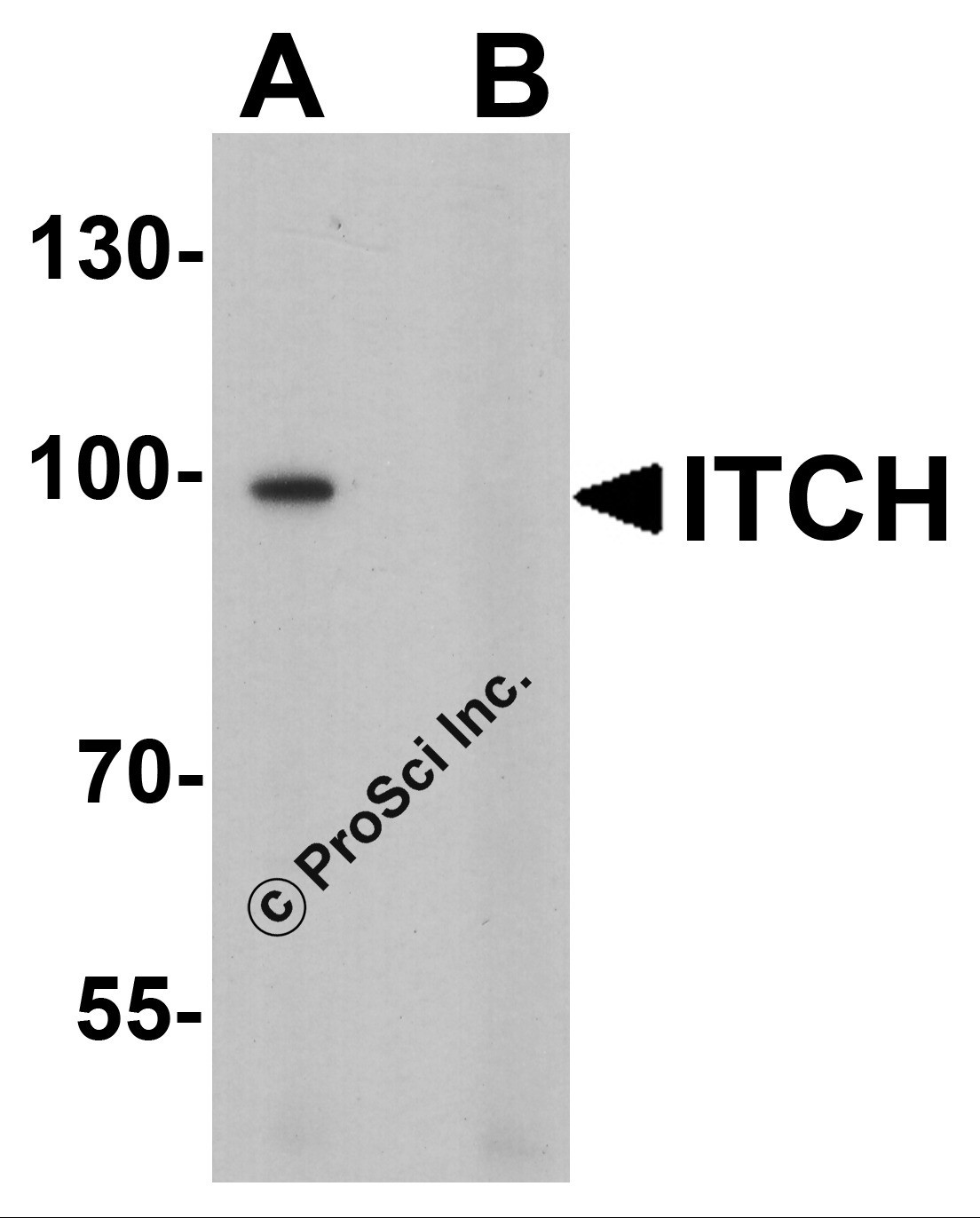
Western blot analysis of ITCH in 3T3 cell lysate with ITCH antibody at 1 μg/ml in (A) the absence and (B) the presence of blocking peptide.| Product Name | ITCH Antibody |
|---|---|
| Antibody Type | Primary Antibodies |
| Product description | The Itchy E3 ubiquitin protein ligase (ITCH) is a member of the Nedd4 family of HECT domain E3 ubiquitin ligases (1). HECT domain E3 ubiquitin ligases transfer ubiquitin from E2 ubiquitin-conjugating enzymes to protein substrates, thus targeting specific proteins for lysosomal degradation. ITCH plays a role in multiple cellular processes including erythroid and lymphoid cell differentiation and the regulation of immune responses (2). In B cells, ITCH is thought to associate with latent membrane protein 2A (LMP2A) of Epstein-Barr virus, specifically down-regulating its activity in B cell signaling (3). Mutations in this gene are a cause of syndromic multisystem autoimmune disease (4).1) Perry WL, Hustad CM, Swing DA, et al. The itchy locus encodes a novel ubiquitin protein ligase that is disrupted in a18H mice. Nat. Genet. 1998; 18:143-6. |
| Immunogen | ITCH antibody was raised against a 15 amino acid peptide near the amino terminus of human ITCH . The immunogen is located within amino acids 40 - 90 of ITCH. |
| Clonality | Polyclonal |
|---|---|
| Isotype | IgG |
| Host Species | Rabbit |
| Tested Applications | WB |
| ITCH antibody can be used for detection of ITCH by Western blot at 1 - 2 μg/ml. | |
| Species Reactivity | MouseRat |
| Concentration | 1mg/ml |
| Purification | Affinity purified |
| Gene Symbol | ITCH |
|---|---|
| Alternative Names | ITCH Antibody: AIF4 AIP4 NAPP1 dJ468O1.1 E3 ubiquitin-protein ligase Itchy homolog Atrophin-1-interacting protein 4 Itch |
| Molecular Weight(MW) | Predicted: 99 kDa Observed: 99 kDa |
| Tissue Specificity | ITCH antibody is human, mouse and rat reactive. At least three isoforms of ITCH are known to exist; this antibody only recognizes the two longest isoforms. This antibody is predicted to not cross-react with other members of the Nedd4 protein family. |
| Entrez Gene | 83737 |
|---|---|
| Protein Accession | NP_001244066 |
Application
Western blot analysis of ITCH in 3T3 cell lysate with ITCH antibody at 1 μg/ml in (A) the absence and (B) the presence of blocking peptide.| Positive Control | 1) Cat. No. 1282 - 3T3 (NIH) Cell Lysate |
|---|---|
| Application Notes | ITCH antibody can be used for detection of ITCH by Western blot at 1 - 2 μg/ml. |
| Form | Liquid |
|---|---|
| Storage Instructions | ITCH antibody can be stored at 4˚C for three months and -20˚C, stable for up to one year. |
| Storage Buffer | ITCH antibody is supplied in PBS containing 0.02% sodium azide. |


