Application
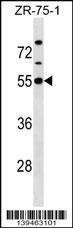
Western blot analysis in ZR-75-1 cell line lysates (35ug/lane).| Product Name | KCNJ1 Antibody |
|---|---|
| Antibody Type | Primary Antibodies |
| Antigen Alias | ATP-sensitive inward rectifier potassium channel 1, ATP-regulated potassium channel ROM-K, Inward rectifier K(+) channel Kir11, Potassium channel, inwardly rectifying subfamily J member 1, KCNJ1, ROMK1 |
| Product description | Potassium channels are present in most mammalian cells, where they participate in a wide range of physiologic responses. The protein encoded by this gene is an integral membrane protein and inward-rectifier type potassium channel. It is activated by internal ATP and probably plays an important role in potassium homeostasis. The encoded protein has a greater tendency to allow potassium to flow into a cell rather than out of a cell. Mutations in this gene have been associated with antenatal Bartter syndrome, which is characterized by salt wasting, hypokalemic alkalosis, hypercalciuria, and low blood pressure. Multiple transcript variants encoding different isoforms have been found for this gene.1) Bailey, S.D., et al. Diabetes Care 33(10):2250-2253(2010) |
| Immunogen | This KCNJ1 antibody is generated from rabbits immunized with a KLH conjugated synthetic peptide between 345-374 amino acids from the C-terminal region of human KCNJ1. |
| Clonality | Polyclonal |
|---|---|
| Isotype | Ig |
| Host Species | Rabbit |
| Tested Applications | WB |
| For WB starting dilution is: 1:1000: |
|
| Species Reactivity | Human |
| Concentration | 1mg/ml |
| Purification | Affinity purified |
| Gene Symbol | KCNJ1 |
|---|---|
| Alternative Names | ATP-sensitive inward rectifier potassium channel 1 ATP-regulated potassium channel ROM-K Inward rectifier K(+) channel Kir11 Potassium channel inwardly rectifying subfamily J member 1 KCNJ1 ROMK1 |
| Molecular Weight(MW) | 45 kDa |
Application
Western blot analysis in ZR-75-1 cell line lysates (35ug/lane).| Application Notes | For WB starting dilution is: 1:1000: |
|---|
| Form | Liquid |
|---|---|
| Storage Instructions | Store at 4˚C for three months and -20˚C, stable for up to one year. As with all antibodies care should be taken to avoid repeated freeze thaw cycles. Antibodies should not be exposed to prolonged high temperatures. |
| Storage Buffer | Supplied in PBS with 0.09% (W/V) sodium azide. |


