Application
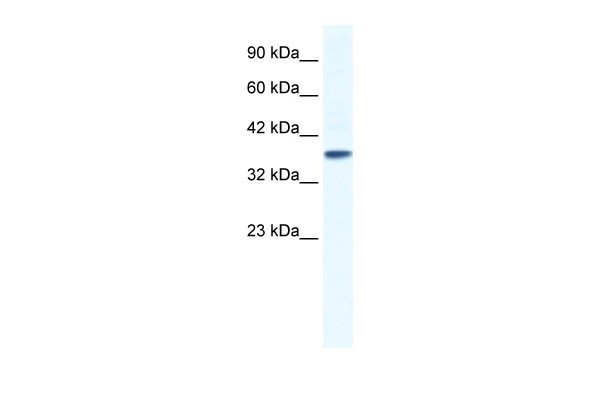
Antibody used in WB on Human Jurkat 1.25 ug/ml.| Product Name | KCNK3 Antibody |
|---|---|
| Antibody Type | Primary Antibodies |
| Product description | KCNK3 encodes one of the members of the superfamily of potassium channel proteins containing two pore-forming P domains. The gene product is an outwardly rectifying channel that is sensitive to changes in extracellular pH and is inhibited by extracellular acidification. Also referred to as an acid-sensitive potassium channel, it is activated by the anesthetics halothane and isoflurane. Although three transcripts are detected in northern blots, there is currently no sequence available to confirm transcript variants for this gene.1) Rusznak, Z., et al., (2004) Cell. Mol. Life Sci. 61 (12), 1532-1542. |
| Immunogen | Antibody produced in rabbits immunized with a synthetic peptide corresponding a region of human KCNK3. |
| Clonality | Polyclonal |
|---|---|
| Host Species | Rabbit |
| Tested Applications | ELISAWB |
| KCNK3 antibody can be used for detection of KCNK3 by ELISA at 1:1562500. KCNK3 antibody can be used for detection of KCNK3 by western blot at 1.25 μg/mL, and HRP conjugated secondary antibody should be diluted 1:50,000 - 100,000. | |
| Species Reactivity | DogHumanMouseRat |
| Concentration | 1mg/ml |
| Purification | Protein A |
| Gene Symbol | KCNK3 |
|---|---|
| Alternative Names | KCNK3 OAT1 PPH4 TASK TBAK1 K2p3.1 TASK-1 |
| Molecular Weight(MW) | 43 kDa |
Application
Antibody used in WB on Human Jurkat 1.25 ug/ml.| Positive Control | 1) Cat. No. 1205 - Jurkat Cell Lysate |
|---|---|
| Application Notes | KCNK3 antibody can be used for detection of KCNK3 by ELISA at 1:1562500. KCNK3 antibody can be used for detection of KCNK3 by western blot at 1.25 μg/mL, and HRP conjugated secondary antibody should be diluted 1:50,000 - 100,000. |
| Form | Liquid |
|---|---|
| Storage Instructions | For short periods of storage (days) store at 4˚C. For longer periods of storage, store KCNK3 antibody at -20˚C. As with any antibody avoid repeat freeze-thaw cycles. |
| Storage Buffer | IgG in phosphate buffered saline , pH 7.4, 150mM NaCl, 0.02% sodium azide and 50% glycerol.Store at -20 °C.Stable for 12 months from date of receipt |


