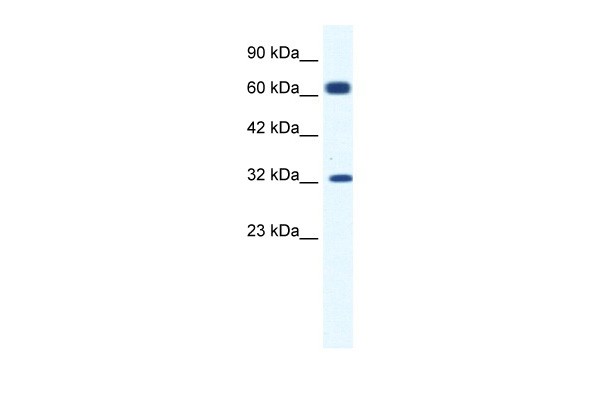
Application
Antibody used in WB on Human Jurkat 1.25 ug/ml.| Product Name | KCNN1 Antibody |
|---|---|
| Antibody Type | Primary Antibodies |
| Product description | Action potentials in vertebrate neurons are followed by an afterhyperpolarization (AHP) that may persist for several seconds and may have profound consequences for the firing pattern of the neuron. Each component of the AHP is kinetically distinct and is mediated by different calcium-activated potassium channels. The protein encoded by this gene is activated before membrane hyperpolarization and is thought to regulate neuronal excitability by contributing to the slow component of synaptic AHP. The encoded protein is an integral membrane protein that forms a voltage-independent calcium-activated channel with three other calmodulin-binding subunits. KCNN1 is a member of the KCNN family of potassium channels.1) Arnold, S.J., et al., (2003) Neuroreport 14 (2), 191-195. |
| Immunogen | Antibody produced in rabbits immunized with a synthetic peptide corresponding a region of human KCNN1. |
| Clonality | Polyclonal |
|---|---|
| Host Species | Rabbit |
| Tested Applications | ELISAWB |
| KCNN1 antibody can be used for detection of KCNN1 by ELISA at 1:312500. KCNN1 antibody can be used for detection of KCNN1 by western blot at 1.25 μg/mL, and HRP conjugated secondary antibody should be diluted 1:50,000 - 100,000. | |
| Species Reactivity | Human |
| Concentration | 1mg/ml |
| Purification | Protein A |
| Gene Symbol | KCNN1 |
|---|---|
| Alternative Names | KCNN1 SK1 hSK1 SKCA1 KCa2.1 |
| Molecular Weight(MW) | 60 kDa |
Application
Antibody used in WB on Human Jurkat 1.25 ug/ml.| Positive Control | 1) Cat. No. 1205 - Jurkat Cell Lysate |
|---|---|
| Application Notes | KCNN1 antibody can be used for detection of KCNN1 by ELISA at 1:312500. KCNN1 antibody can be used for detection of KCNN1 by western blot at 1.25 μg/mL, and HRP conjugated secondary antibody should be diluted 1:50,000 - 100,000. |
| Form | Liquid |
|---|---|
| Storage Instructions | For short periods of storage (days) store at 4˚C. For longer periods of storage, store KCNN1 antibody at -20˚C. As with any antibody avoid repeat freeze-thaw cycles. |
| Storage Buffer | IgG in phosphate buffered saline , pH 7.4, 150mM NaCl, 0.02% sodium azide and 50% glycerol.Store at -20 °C.Stable for 12 months from date of receipt |


