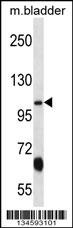
Application
Western blot analysis in mouse bladder tissue lysates (35ug/lane).| Product Name | KCNQ3 Antibody |
|---|---|
| Antibody Type | Primary Antibodies |
| Product description | The M channel is a slowly activating and deactivating potassium channel that plays a critical role in the regulation of neuronal excitability. The M channel is formed by the association of the protein encoded by this gene and one of two related proteins encoded by the KCNQ2 and KCNQ5 genes, both integral membrane proteins. M channel currents are inhibited by M1 muscarinic acetylcholine receptors and activated by retigabine, a novel anti-convulsant drug. Defects in this gene are a cause of benign familial neonatal convulsions type 2 (BFNC2), also known as epilepsy, benign neonatal type 2 (EBN2).1) Bailey, S.D., et al. Diabetes Care (2010) In press : |
| Immunogen | This KCNQ3 antibody is generated from rabbits immunized with a KLH conjugated synthetic peptide between 651-679 amino acids from the C-terminal region of human KCNQ3. |
| Clonality | Polyclonal |
|---|---|
| Isotype | Ig |
| Host Species | Rabbit |
| Tested Applications | WB |
| For WB starting dilution is: 1:1000 | |
| Species Reactivity | Mouse |
| Concentration | 1mg/ml |
| Purification | Affinity purified |
| Gene Symbol | KCNQ3 |
|---|---|
| Alternative Names | Potassium voltage-gated channel subfamily KQT member 3 KQT-like 3 Potassium channel subunit alpha KvLQT3 Voltage-gated potassium channel subunit Kv73 KCNQ3 |
| Molecular Weight(MW) | 97 kDa |
Application
Western blot analysis in mouse bladder tissue lysates (35ug/lane).| Application Notes | For WB starting dilution is: 1:1000 |
|---|
| Form | Liquid |
|---|---|
| Storage Instructions | Store at 4˚C for three months and -20˚C, stable for up to one year. As with all antibodies care should be taken to avoid repeated freeze thaw cycles. Antibodies should not be exposed to prolonged high temperatures. |
| Storage Buffer | Supplied in PBS with 0.09% (W/V) sodium azide. |


