Application
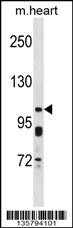
Western blot analysis in mouse heart tissue lysates (35ug/lane).Application
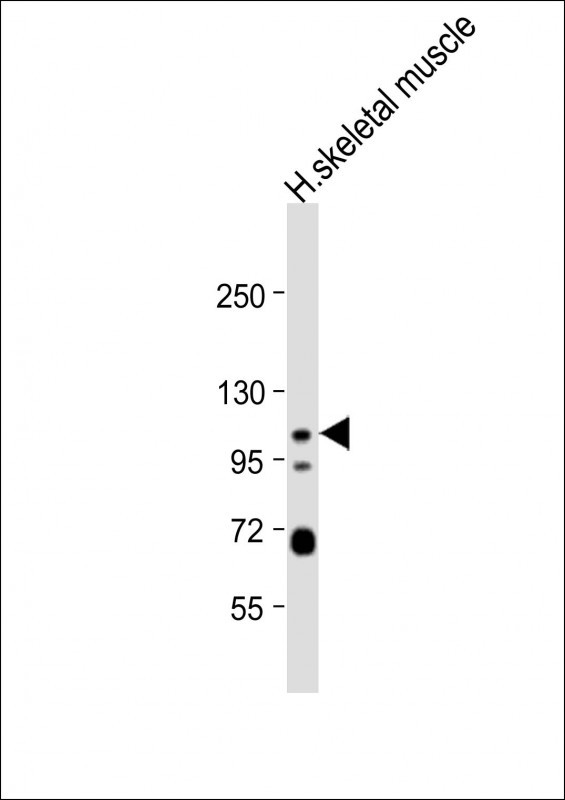
Western Blot at 1:1000 dilution + human skeletal muscle lysate Lysates/proteins at 20 ug per lane.| Product Name | KCNQ5 Antibody |
|---|---|
| Antibody Type | Primary Antibodies |
| Product description | This gene is a member of the KCNQ potassium channel gene family that is differentially expressed in subregions of the brain and in skeletal muscle. The protein encoded by this gene yields currents that activate slowly with depolarization and can form heteromeric channels with the protein encoded by the KCNQ3 gene. Currents expressed from this protein have voltage dependences and inhibitor sensitivities in common with M-currents. They are also inhibited by M1 muscarinic receptor activation. Multiple transcript variants encoding different isoforms have been found for this gene.1) Bailey, S.D., et al. Diabetes Care (2010) In press : |
| Immunogen | This KCNQ5 antibody is generated from rabbits immunized with a KLH conjugated synthetic peptide between 781-809 amino acids from the C-terminal region of human KCNQ5. |
| Clonality | Polyclonal |
|---|---|
| Isotype | Ig |
| Host Species | Rabbit |
| Tested Applications | WB |
| For WB starting dilution is: 1:1000 | |
| Species Reactivity | HumanMouse |
| Concentration | 1mg/ml |
| Purification | Affinity purified |
| Gene Symbol | KCNQ5 |
|---|---|
| Alternative Names | Potassium voltage-gated channel subfamily KQT member 5 KQT-like 5 Potassium channel subunit alpha KvLQT5 Voltage-gated potassium channel subunit Kv75 KCNQ5 |
| Molecular Weight(MW) | 102 kDa |
Application
Western blot analysis in mouse heart tissue lysates (35ug/lane).
Application
Western Blot at 1:1000 dilution + human skeletal muscle lysate Lysates/proteins at 20 ug per lane.| Application Notes | For WB starting dilution is: 1:1000 |
|---|
| Form | Liquid |
|---|---|
| Storage Instructions | Store at 4˚C for three months and -20˚C, stable for up to one year. As with all antibodies care should be taken to avoid repeated freeze thaw cycles. Antibodies should not be exposed to prolonged high temperatures. |
| Storage Buffer | Supplied in PBS with 0.09% (W/V) sodium azide. |


