Application
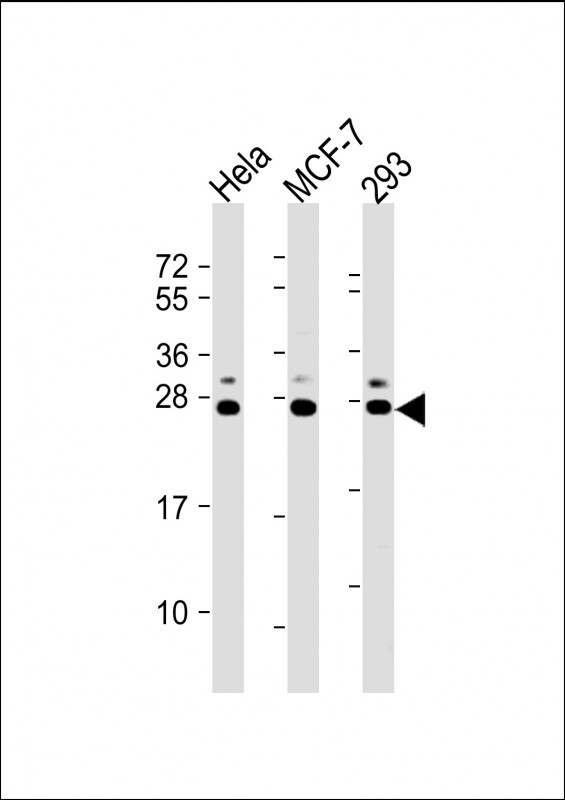
Western Blot at 1:2000 dilution Lane 1: Hela whole cell lysate Lane 2: MCF-7 whole cell lysate Lane 3: 293 whole cell lysate Lysates/proteins at 20 ug per lane.| Product Name | KDELR1 Antibody |
|---|---|
| Antibody Type | Primary Antibodies |
| Product description | Retention of resident soluble proteins in the lumen of the endoplasmic reticulum (ER) is achieved in both yeast and animal cells by their continual retrieval from the cis-Golgi, or a pre-Golgi compartment. Sorting of these proteins is dependent on a C-terminal tetrapeptide signal, usually lys-asp-glu-leu (KDEL) in animal cells, and his-asp-glu-leu (HDEL) in S. cerevisiae. This process is mediated by a receptor that recognizes, and binds the tetrapeptide-containing protein, and returns it to the ER. In yeast, the sorting receptor encoded by a single gene, ERD2, which is a seven-transmembrane protein. Unlike yeast, several human homologs of the ERD2 gene, constituting the KDEL receptor gene family, have been described. The protein encoded by this gene was the first member of the family to be identified, and it encodes a protein structurally and functionally similar to the yeast ERD2 gene product.1) Ewing, R.M., et al. Mol. Syst. Biol. 3, 89 (2007) : |
| Immunogen | This KDELR1 antibody is generated from rabbits immunized with a KLH conjugated synthetic peptide between 185-211 amino acids from the C-terminal region of human KDELR1. |
| Clonality | Polyclonal |
|---|---|
| Isotype | Ig |
| Host Species | Rabbit |
| Tested Applications | WB |
| For WB starting dilution is: 1:2000 | |
| Species Reactivity | Human |
| Concentration | 1mg/ml |
| Purification | Affinity purified |
| Gene Symbol | KDELR1 |
|---|---|
| Alternative Names | ER lumen protein-retaining receptor 1 KDEL endoplasmic reticulum protein retention receptor 1 KDEL receptor 1 Putative MAPK-activating protein PM23 KDELR1 ERD21 |
| Molecular Weight(MW) | 25 kDa |
| Sequence Similarities | Predicted species reactivity based on immunogen sequence: Mouse |
Application
Western Blot at 1:2000 dilution Lane 1: Hela whole cell lysate Lane 2: MCF-7 whole cell lysate Lane 3: 293 whole cell lysate Lysates/proteins at 20 ug per lane.| Application Notes | For WB starting dilution is: 1:2000 |
|---|
| Form | Liquid |
|---|---|
| Storage Instructions | Store at 4˚C for three months and -20˚C, stable for up to one year. As with all antibodies care should be taken to avoid repeated freeze thaw cycles. Antibodies should not be exposed to prolonged high temperatures. |
| Storage Buffer | Supplied in PBS with 0.09% (W/V) sodium azide. |


