Application
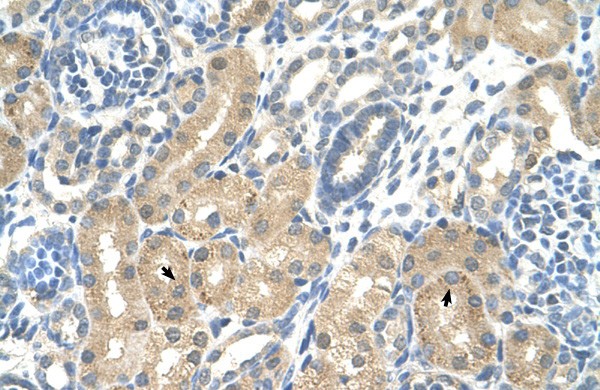
Antibody used in IHC on Human Kidney at 4.0-8.0 ug/ml.| Product Name | KHK Antibody |
|---|---|
| Antibody Type | Primary Antibodies |
| Product description | KHK is a ketohexokinase that catalyzes conversion of fructose to fructose-1-phosphate. The product of this gene is the first enzyme with a specialized pathway that catabolizes dietary fructose.KHK encodes the gene ketohexokinase that catalyzes conversion of fructose to fructose-1-phosphate. The splice variant presented encodes the highly active form found in liver, renal cortex, and small intestine, while the alternate variant encodes the lower activity form found in most other tissues.1) Hwa, J.S., (2006) Proteomics 6 (3), 1077-1084. |
| Immunogen | Antibody produced in rabbits immunized with a synthetic peptide corresponding a region of human KHK. |
| Clonality | Polyclonal |
|---|---|
| Host Species | Rabbit |
| Tested Applications | IHCWB |
| KHK antibody can be used for detection of KHK by ELISA at 1:312500. KHK antibody can be used for detection of KHK by western blot at 1.0 μg/mL, and HRP conjugated secondary antibody should be diluted 1:50,000 - 100,000. | |
| Species Reactivity | Human |
| Concentration | 1mg/ml |
| Purification | Affinity purified |
| Gene Symbol | KHK |
|---|---|
| Alternative Names | KHK |
| Molecular Weight(MW) | 33 kDa, 33 kDa |
Application
Antibody used in IHC on Human Kidney at 4.0-8.0 ug/ml.| Positive Control | 1) Cat. No. XBL-10409 - Fetal Liver Tissue Lysate |
|---|---|
| Application Notes | KHK antibody can be used for detection of KHK by ELISA at 1:312500. KHK antibody can be used for detection of KHK by western blot at 1.0 μg/mL, and HRP conjugated secondary antibody should be diluted 1:50,000 - 100,000. |
| Form | Liquid |
|---|---|
| Storage Instructions | For short periods of storage (days) store at 4˚C. For longer periods of storage, store KHK antibody at -20˚C. As with any antibody avoid repeat freeze-thaw cycles. |
| Storage Buffer | Antibody is lyophilized in PBS buffer with 2% sucrose. Add 50 μL of distilled water. Final antibody concentration is 1 mg/mL. |


